
Steps
8, from country choice to visa
Nepal-specific
NOC from the Ministry of Education
Start planning
6 to 12 months before you fly
Rules change
Check official sites when you apply
Quick Answer
To study abroad from Nepal you choose a country and course, apply to universities, prove your English level, get a No Objection Certificate (NOC) from Nepal's Ministry of Education, show proof of funds, then apply for your visa. Rules differ by country. For example, the UK asks for £1,203 to £1,570 a month for up to 9 months from November 30, 2026 (£1,171 to £1,529 before that date), held for 28 days, Canada capped study permit applications at 309,670 for 2026, and Germany asks for €11,904 in a blocked account.
The 8 steps at a glance
- Choose a country and course that fits your budget and goals.
- Apply to universities and collect your offers.
- Prove your English level.
- Get your NOC from Nepal's Ministry of Education and Sports.
- Arrange your money: tuition, living funds and the tax on foreign payments.
- Complete health and document checks.
- Apply for your visa.
- Prepare to travel.
The sections below explain each step with the figures that apply to the most popular destinations. Every number is checked against an official source, and we list the sources at the end.
Step 1: Choose a country and course
Compare countries on cost, work rights after study and visa risk, not on rankings alone. These are the 2026 facts that most affect Nepali students:
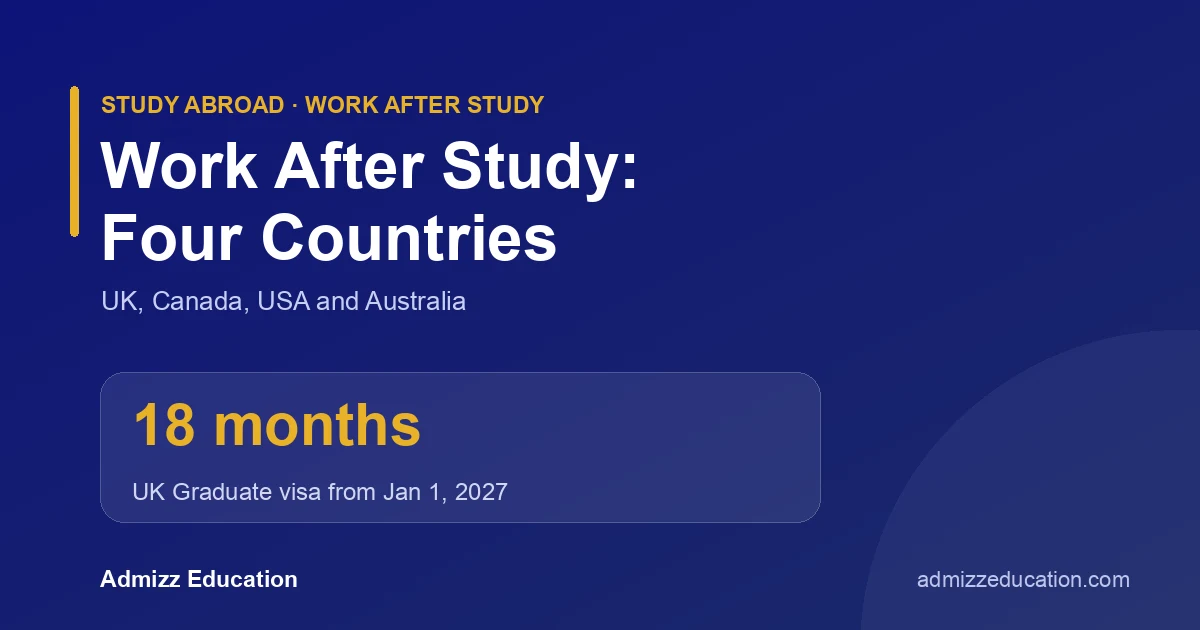
- UK: one-year Master's degrees. The Graduate visa is 18 months for applications from January 1, 2027, and 2 years before that date. See our UK student visa guide.
- Canada: study permit applications are capped at 309,670 for 2026, and most new bachelor's and college applicants need a provincial attestation letter. Master's students at public institutions are exempt. See the Canada cap guide.
- Germany: proof of funds of €11,904 a year through a blocked account. See the Germany guide.
- USA: from September 15, 2026, F-1 students are admitted for a fixed period of up to four years. See the H-1B guide and our F-1 versus UK comparison.
- Australia: new Student visa rules took effect on October 2, 2026. See all rule changes.
Study destinations compared: visa fees and funds at a glance
Costs and funds are the quickest way to narrow your list. These are the official figures as checked in October 2026:
- UK: student visa £558, plus the £776-a-year health surcharge. Show £1,171 a month outside London (£1,529 in London) for up to 9 months, held for 28 days. For applications from November 30, 2026 the amounts are £1,203 and £1,570. After study, the Graduate visa lasts 18 months for applications from January 1, 2027.
- USA: US$185 visa application fee plus the US$350 SEVIS fee. You must show how you will pay for your studies. After study, OPT applies, and STEM OPT adds 24 months for eligible STEM graduates.
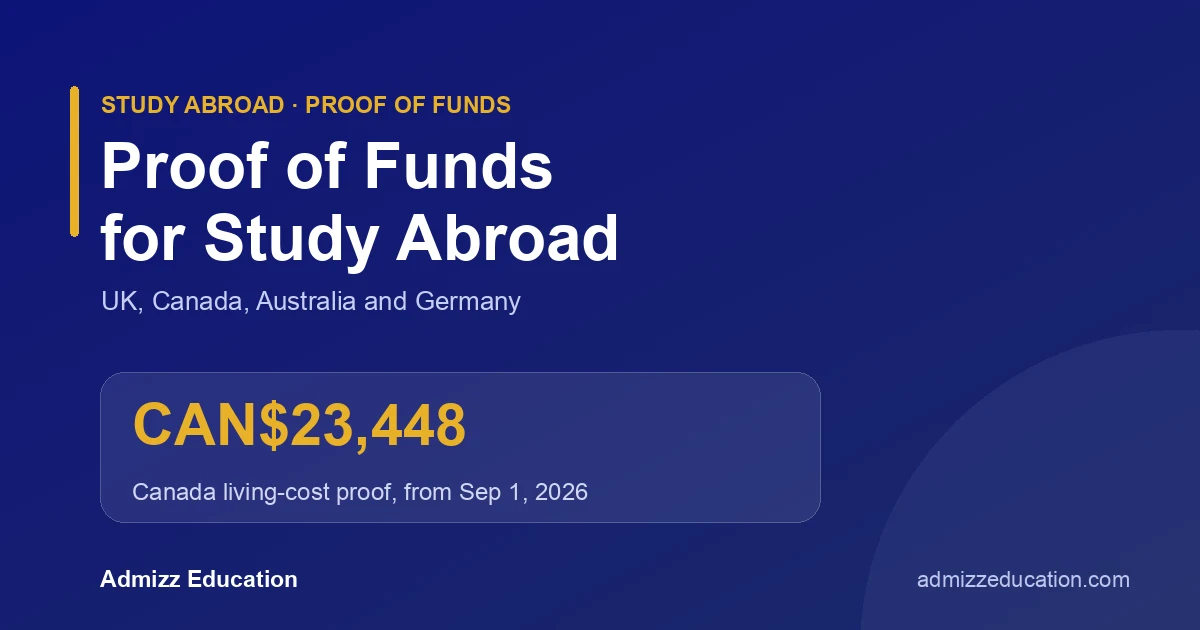
- Canada: CAN$150 study permit and CAN$85 biometrics. For applications from September 1, 2026, show CAN$23,448 for living costs plus first-year tuition and travel.
- Australia: the student visa application charge is AUD 2,500 from July 1, 2026. Study Australia says to show at least AUD 29,710 and to hold compulsory health cover (OSHC).
- Germany: €11,904 a year in a blocked account.
If your budget is tight, compare the funds line first, because it is the money you must hold before you can apply. Then compare work rights after study. Our guides cover each country in detail: UK, USA, Canada and Australia.
Step 2: Apply to universities
Shortlist courses, check entry requirements and apply. For UK study, check the marks each university expects. See the GPA guide and the intake timeline.
Many universities ask for a deposit before they issue the document you need for your visa. A deposit you have paid is normally deducted from the tuition you must show, so ask each university how it works.
Step 3: Prove your English level
The test and score depend on the country and the university. For a UK Student visa, degree-level courses need CEFR level B2 and courses below degree level need B1. You can use an approved Secure English Language Test, and for degree-level courses your university may assess your English itself, according to GOV.UK: Student visa, knowledge of English.
Not sure which test to take? Read our guide to IELTS versus PTE, and book early because results can take time.
Step 4: Get your NOC
Nepal's Ministry of Education and Sports issues a No Objection Certificate for students going abroad to study. It is applied for online. Our NOC guide explains who needs one, the documents and the process. Check the ministry's portal for the current fee before you apply.
Step 5: Arrange your money
You will need money for three things: tuition, living costs and the tax on foreign payments.
- Funds for the visa. The UK asks for £1,171 a month outside London or £1,529 in London for applications before November 30, 2026, and £1,203 or £1,570 for applications from that date, for up to 9 months, held for 28 days in a row, plus unpaid first-year tuition. Read about the bank balance and the 28-day rule. Germany asks for €11,904 a year, which is €992 a month.
- Tax on tuition payments. Nepal charges a tax on tuition payments sent to foreign institutions. The rate was raised to 3% in the 2023 budget, according to ICEF Monitor. Check the current rate with your bank before you transfer.
- Total cost. See our full UK cost breakdown and total cost guide.
Step 6: Health and document checks
Rules differ by country. For the UK, you need a tuberculosis test if you are coming for 6 months or more and have lived in a listed country, and Nepal is on that list. The test must be done at an approved clinic, and the certificate is valid for 6 months from the date of your x-ray, according to GOV.UK: TB test for a UK visa.
Gather your passport, academic documents, offer and funds evidence in one folder. Make sure names and dates match across every document.
Step 7: Apply for your visa
For a UK Student visa you can apply up to 6 months before your course starts, and GOV.UK says you will usually get a decision within 3 weeks if you apply from outside the UK. Follow our step-by-step UK visa guide, practice with the interview guide, and read the common reasons for refusal.
If you plan to bring family, check the rules first. See UK dependants rules.
Step 8: Prepare to travel
Once your visa arrives, book flights, arrange accommodation and plan your first month's budget. Do not book non-refundable travel before you have the decision. Keep digital and paper copies of every document.
A simple timeline
- 9 to 12 months before: choose countries and courses, book your English test.
- 6 to 9 months before: apply to universities, apply for scholarships. See UK scholarships.
- 4 to 6 months before: accept your offer, apply for your NOC, start your funds window five to six weeks before you plan to apply for the visa.
- Up to 6 months before the course starts: apply for the UK visa.
- Before travel: book flights and accommodation.
This is a planning guide, not a rule. Each country and university sets its own deadlines.
Common mistakes to avoid
- Starting the funds window too late
- Choosing a country without checking the current rules
- Documents that do not match each other
- Relying on a consultant for guarantees nobody can give
- Missing English test or deposit deadlines
If you use a consultancy, check it first. Our checklist for choosing a genuine education consultancy has ten questions to ask.
How Admizz Education can help
Admizz Education is an ICEF-accredited agency that has helped students apply abroad since 2015. We support course and university selection, test preparation, scholarships and visa preparation. You can start with our visa assistance service or book a free consultation. Learn more about our accreditation and results.
Sources
- GOV.UK: Student visa
- US Department of State: Student visa
- ICE: I-901 SEVIS fee
- IRCC: Proof of financial support
- Study Australia: Student visa (subclass 500)
- GOV.UK: Student visa, knowledge of English
- GOV.UK: Student visa, money you need
- OTS Solicitors: student visa maintenance funds increase from November 30, 2026
- GOV.UK: Student visa, apply
- GOV.UK: TB test for a UK visa
- IRCC: 2026 provincial and territorial allocations under the international student cap
- ICEF Monitor: Nepal increases taxes for students studying abroad
Figures checked in October 2026. Rules change, so check the official site on the day you apply.
Frequently Asked Questions
How do I study abroad from Nepal?
Choose a country and course, apply to universities, prove your English level, get your NOC, show proof of funds, and apply for your visa. The exact documents and amounts depend on the country.
Do I need an NOC to study abroad from Nepal?
Nepal's Ministry of Education and Sports issues a No Objection Certificate for students going abroad to study. Check the ministry's portal and our NOC guide for who needs one and how to apply.
How much money do I need to study in the UK from Nepal?
For UK applications from November 30, 2026, you must show £1,203 a month outside London or £1,570 in London for up to 9 months (£1,171 and £1,529 before that date), plus your unpaid first-year tuition, held for 28 days in a row.
Do I need IELTS to study abroad from Nepal?
It depends on the country and university. For a UK degree-level course you need CEFR level B2, which you can show with an approved English test or, for degree-level courses, a university assessment.
When should I start planning to study abroad?
Start 9 to 12 months before your course begins. For a UK visa you can apply up to 6 months before the course starts.
Book a Free Counseling Session