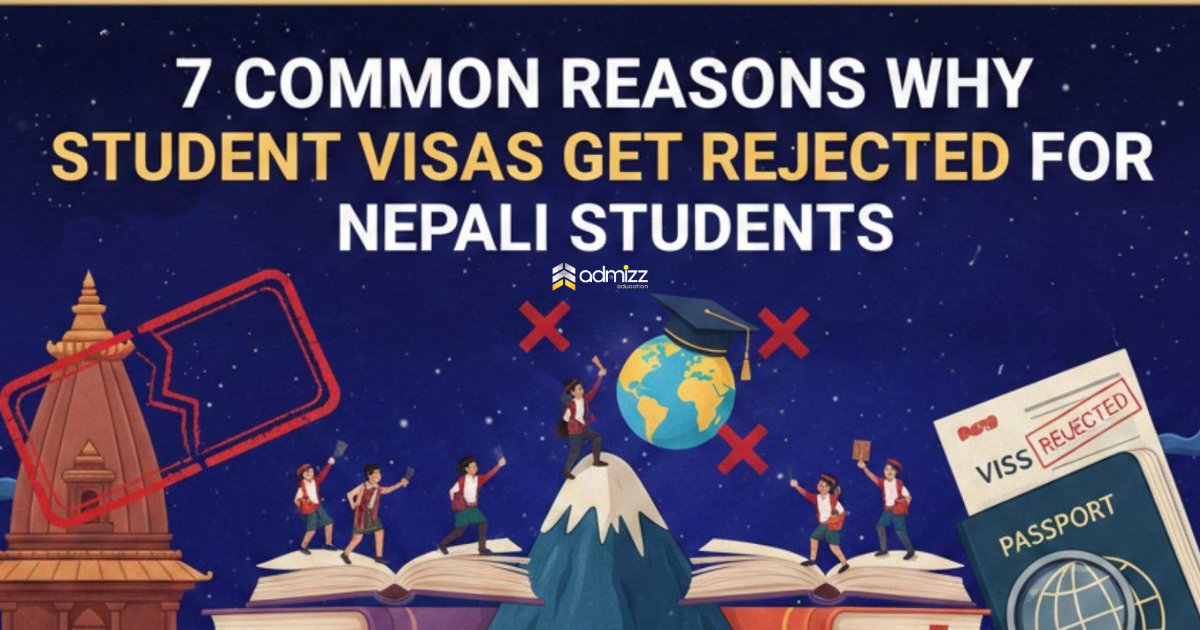
Are you dreaming of studying abroad but terrified your visa might get rejected? You’re not alone. Every year, thousands of Nepali students face the heartbreak of a student visa refusal — often for reasons that were entirely preventable.
The good news? Most visa rejections share the same patterns. Once you know what those patterns are, you can take deliberate steps to avoid them.
In this guide, we break down the 7 most common reasons student visas get rejected for Nepali students — and, more importantly, what you can do right now to strengthen your application.
1. Weak or Unclear Statement of Purpose (SOP)
Without a doubt, the Statement of Purpose is one of the most critical documents in your visa application — yet it’s also the most commonly mishandled.
Many Nepali students make the mistake of writing a generic SOP that could apply to anyone. Visa officers read hundreds of these every day. If yours doesn’t clearly explain why you chose that specific country, institution, and course, it immediately raises doubts about your genuine intent to study.
What visa officers look for:
- A logical connection between your academic background and your chosen program
- Clear reasons why you selected that particular university and destination country
- A realistic plan for your future after graduation — ideally back in Nepal
How to fix it: Write your SOP from scratch, making it specific and personal. Avoid copying templates. Every sentence should reflect your story, not a borrowed one.
2. Insufficient or Unverifiable Financial Proof
Perhaps the single most common reason for student visa rejections is insufficient financial documentation, which signals to visa officers that you may not be able to support yourself during your studies.
But here’s what many students don’t realize: it’s not just about having the money — it’s about proving where it came from.
Visa officers look for financial consistency. If a large sum of money suddenly appeared in a bank account just weeks before the application, that’s a major red flag. Similarly, documents that don’t match (for example, a bank statement from one institution but a sponsor letter from another) create doubt.
Common financial documentation mistakes include:
- Bank statements that show sudden, unexplained deposits
- Inconsistency between the bank balance and the claimed income sources
- Missing or vague sponsor letters
- Funds that appear far below the cost of the intended program
How to fix it: Maintain a steady, well-documented bank balance for at least 3–6 months before applying. Ensure your financial documents — bank statements, income certificates, property papers — all tell a coherent and verifiable story.
3. Failure to Demonstrate Intent to Return to Nepal
This is a subtler issue, but it’s one that directly affects students from countries like Nepal, which are classified as high-emigration-risk nations by many immigration authorities.
Visa officers must be satisfied that you genuinely intend to return home after completing your studies — not remain in the destination country illegally. If your application doesn’t address this concern, it creates an impression of immigration risk.
Signs that raise red flags:
- No mention of future career plans in Nepal
- Family ties that appear weak or undocumented
- Applying for a visa that’s out of proportion to your academic background or career goals
How to fix it: Explicitly highlight your ties to Nepal in your application — family, property, career prospects, community connections. A well-written SOP that outlines your post-study plan in Nepal can make a significant difference here.
4. Choosing the Wrong University or Course (Lack of Genuine Temporary Entrant Intent)
This is a growing issue, particularly for countries like Australia and Canada that use the Genuine Temporary Entrant (GTE) or Student Direct Stream (SDS) criteria.
If the course you’ve applied for doesn’t align logically with your academic background or career aspirations, visa officers may question whether you’re genuinely there to study — or simply using student status as a migration pathway.
For example, if you studied engineering in Nepal but suddenly apply for a hospitality management course abroad with no clear reason, that inconsistency raises concerns.
How to fix it: Choose courses that genuinely connect to your existing qualifications and future goals. If you’re making a career switch, explain the transition clearly and convincingly in your SOP.
5. Incomplete or Incorrectly Submitted Documentation
This one might seem basic — but it’s surprisingly common. Missing a single document, submitting an outdated transcript, or failing to get documents notarized properly can result in an outright rejection.
Moreover, errors in the application form itself — wrong dates, inconsistent names across documents, or missing signatures — can raise concerns about the authenticity of your application.
Documents commonly missed or incorrectly submitted:
- Academic transcripts (unofficial copies instead of official sealed ones)
- English proficiency test scores (expired IELTS/TOEFL results)
- Passport photos that don’t meet specification
- Health insurance documentation (required for some countries)
- Missing police clearance certificate
How to fix it: Create a detailed checklist for every document required by the embassy or consulate. Have a professional review your documents before submission. Double-check that names, dates, and document numbers are consistent across all forms.
6. Low or Inconsistent Academic Performance
While having a perfect academic record isn’t always mandatory, a history of poor grades — especially in subjects related to your chosen course — can weaken your case significantly.
Visa officers, and often university admissions teams, want to see evidence that you can handle the academic rigor of the program you’ve applied to. If your transcripts show repeated failures or significant gaps in education, questions arise about your genuine capability and intent.
How to fix it: If your academic record isn’t strong, compensate by obtaining admission into a reputable, accredited institution. A strong offer letter from a recognized university, combined with a compelling SOP explaining your academic journey and growth, can offset concerns around grades.
Additionally, ensure there are no unexplained gaps in your academic history. If there were gaps, address them honestly and clearly.
7. Previous Visa Rejections or Immigration History
Finally, one of the most overlooked factors: your prior visa history. Many Nepali students aren’t aware that a previous rejection — whether for a student visa, tourist visa, or any other category — must typically be disclosed in future applications.
Failing to disclose a prior rejection is treated as misrepresentation, which can result in an outright ban. On the other hand, disclosing it and addressing it properly, with evidence that the earlier issues have been resolved, can still lead to a successful application.
How to fix it: Always disclose your full immigration history honestly. Work with an experienced education consultant who can help you craft a response that acknowledges the previous rejection and demonstrates why this new application is stronger.
The Bottom Line: Preparation Is Everything
Student visa rejections are rarely random. In the vast majority of cases, they come down to avoidable mistakes — a weak SOP, inconsistent documents, unclear financial proof, or a failure to understand what visa officers are actually looking for.
The students who succeed are the ones who prepare thoroughly, seek expert guidance, and present applications that tell a clear, consistent, and compelling story.
Ready to Get Your Visa Application Right the First Time?
At Admizz Education, we’ve helped hundreds of Nepali students successfully navigate the student visa process — from choosing the right course and institution to preparing airtight documentation and crafting powerful SOPs.
Our team of certified education consultants understands exactly what embassies look for, and we’re here to make sure your application gives you the best possible chance of success.
Don’t leave your future to chance.
Book a Free Consultation with Admizz Education Today
Whether you’re applying for the first time or recovering from a previous rejection, we’re here to guide you every step of the way.
Admizz Education — Your Trusted Partner for Studying Abroad from Nepal
Frequently Asked Questions (FAQ)
Can I reapply after a student visa rejection?
Yes, in most cases, you can reapply. However, it’s essential to understand the specific reason for the rejection and address it before submitting a new application.
How long should I wait before reapplying?
This depends on the country and the reason for rejection. In some cases, you can reapply immediately; in others, you may need to wait a specified period. Consulting an education expert is strongly recommended before reapplying.
Does a student visa rejection affect future visa applications?
A rejection itself doesn’t automatically disqualify you from future applications, but you must disclose it. Failing to disclose prior rejections can have serious consequences.
How can Admizz Education help with my visa application?
Admizz Education provides end-to-end support — including course selection, university applications, SOP writing, document preparation, and visa application guidance — to maximize your chances of success.
Book a Free Counseling Session