
Shape Your Future at World-Class Universities
Choosing the UK for higher studies opens doors to international exposure, employment opportunities, and globally recognized qualifications. From university selection and application support to scholarships, visas, and pre-departure guidance, Admizz Education helps you secure admission to top UK universities with complete confidence.
Learn MoreLondon
Capital
English
Language
+44
Dialing Code
Pound
Currency
67M+
Population
359
Universities
485,555
Intl. Students
£6000/yr
Tuition fee
1500+
Students successfully enrolled worldwide
95%
Student Visa Approval Rate with Expert Guidance
$2M+
In Scholarships Awarded to Our Students
Choosing the UK for higher studies opens doors to international exposure, employment opportunities, and globally recognized qualifications.

Oxford, Cambridge, Manchester, Bristol, Leeds, Birmingham, and more.

1-year master's and 3-year bachelor's degrees.

Stay and work in the UK for 2–3 years after graduation.

Over 50,000+ courses across STEM, business, health, arts, media, aviation & more.

UK graduates are preferred by global employers for their skills and academic quality.

Over 600,000 international students from 180+ countries.
Applying to study in the UK involves a clear set of academic, documentation, and visa-related steps. To help students understand the process better, here is a complete guide to the admission requirements you must prepare before starting your UK education journey.
Universities in the UK require essential academic and personal documents to evaluate your eligibility. The commonly required documents include:
Once you receive a conditional or unconditional offer, the university will issue a CAS letter, which is mandatory for the UK student visa. To receive CAS, you must submit:
For your UK Student Visa, the following documents are required:
The UK offers three major academic intakes, giving flexibility to students:

University of Roehampton

BPP University
University of Greenwich
Buckinghamshire New University

Coventry University
Ulster University

Health Sciences University
Ravensbourne University London
University of Roehampton
BPP University
University of Greenwich
Buckinghamshire New University
Coventry University
Ulster University
Health Sciences University
Ravensbourne University London

University of Sunderland
University of East London

The University of Law

University of Worcester
University of West London
University of the West of Scotland
York St John University
University of Sunderland
University of East London
The University of Law
University of Worcester
University of West London
University of the West of Scotland
York St John University
University of Sunderland
University of East London
The University of Law
University of Worcester
University of West London
University of the West of Scotland
York St John University
University of Sunderland
University of East London
The University of Law
University of Worcester
University of West London
University of the West of Scotland
York St John University
Planning to Study in the UK requires a clear understanding of the overall costs involved.
| Program Type | Tuition Fees (Per Year) |
|---|---|
| Undergraduate | £10,000 – £20,000 |
| Postgraduate | £12,000 – £25,000 |
| MBA / Professional | £20,000 – £35,000+ |
| Living Expenses | £9,000 – £12,000 per year |
| Health Surcharge (NHS) | £470 per year |
Undergraduate
£10,000 – £20,000
Postgraduate
£12,000 – £25,000
MBA / Professional
£20,000 – £35,000+
Living Expenses
£9,000 – £12,000 per year
Health Surcharge (NHS)
£470 per year
Your total costs vary by city. London is higher; smaller cities are more budget friendly.
Applying for a UK Student Visa (formerly Tier 4 Visa) becomes simple when you understand each step clearly. Below is a complete, easy-to-follow breakdown of the UK student visa process.
Select a UKVI-approved institution and the right course.
Apply through UCAS or university portals with required documents.
Get conditional or unconditional offer based on your eligibility.
Maintain sufficient funds for tuition and living expenses.
Take your TB test at a UKVI-approved centre.
Submit documents and fee receipts to receive your CAS number.
Collect CAS, bank proof, TB certificate, transcripts, and passport.
Fill UKVI visa form and pay visa + IHS fees.
Schedule your VFS appointment for biometrics submission.
Submit biometrics and necessary documents at VFS.
Visa processing typically takes 1–3 weeks.
Receive your passport with visa vignette.
Carry all essential documents when flying to the UK.
Pick up your BRP card within 10 days of arrival.
Select a UKVI-approved institution and the right course.
Apply through UCAS or university portals with required documents.
Get conditional or unconditional offer based on your eligibility.
Maintain sufficient funds for tuition and living expenses.
Take your TB test at a UKVI-approved centre.
Submit documents and fee receipts to receive your CAS number.
Collect CAS, bank proof, TB certificate, transcripts, and passport.
Fill UKVI visa form and pay visa + IHS fees.
Schedule your VFS appointment for biometrics submission.
Submit biometrics and necessary documents at VFS.
Visa processing typically takes 1–3 weeks.
Receive your passport with visa vignette.
Carry all essential documents when flying to the UK.
Pick up your BRP card within 10 days of arrival.
Yes, the UK is one of the best study destinations due to its world-class universities, high-quality teaching, global recognition, and excellent career opportunities.
You generally need academic transcripts, English proficiency scores (IELTS/PTE), a valid passport, Statement of Purpose, Letters of Recommendation, and proof of funds.
Tuition fees typically range from £10,000 to £25,000 per year, depending on the course and university. Living expenses may cost £9,000–£12,000 annually.
Most universities require an overall IELTS score of 6.0–6.5, but some top programs may ask for 7.0 or higher.
Yes, international students can work up to 20 hours per week during term time and full-time during holidays.
The standard UK Student Visa usually takes 3–6 weeks for processing, depending on your home country and application accuracy.
Yes, the UK offers plenty of part-time job opportunities in retail, hospitality, customer service, and campus roles.
Absolutely. The Graduate Route (Post-Study Work Visa) allows students to stay and work for 2 years (UG/PG) or 3 years (PhD).
Popular courses include MBA, Data Science, Engineering, Healthcare, Law, Computer Science, Business Analytics, Pharmacy, and Finance.
Yes, most UK universities accept study gaps if properly justified with experience letters, family reasons, medical documents, or valid explanations.
Explore our latest articles about studying in UK — tips, guides, and expert advice to help you succeed.
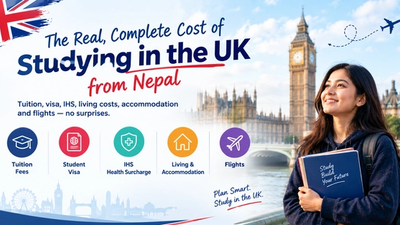
The real, complete cost of studying in the UK from Nepal — tuition, visa, IHS, living costs, accommodation and flights in both GBP and NPR. No surprises.

UK allows 20 hrs, Australia 48 hrs per fortnight, New Zealand 25 hrs, Canada 24 hrs. Confirmed 2026 work hour limits, minimum wages and holiday rules for every major study destination.

UKVI cannot refuse a UK student visa on genuineness grounds without an interview first. Here are the 7 things caseworkers now check — and how to prepare.
Let our expert counselors guide you through university selection, applications, visas, and everything in between.
24hr Response
Average reply time
Free Consultation
No commitment
Expert Team
10+ years experience