The Honest Answer International Students Need in 2026
For years, the USA and the UK have competed for the same international students. Both offer world-class universities, strong graduate employment markets, and globally recognised degrees. But in 2026, the visa experience between these two destinations has diverged dramatically — and the difference is now significant enough to change which one you choose.
This is not a blog about which country is better academically. It is an honest, side-by-side look at what it actually takes to get a student visa in each country right now — refusal rates, wait times, financial requirements, and what happens after you graduate.
Refusal Rates and Processing Times — The Biggest Gap
The most immediate difference between the two visas in 2026 is how likely you are to get one — and how long you will wait to find out.
| Factor | 🇺🇸 US F-1 Visa | 🇬🇧 UK Student Visa |
|---|---|---|
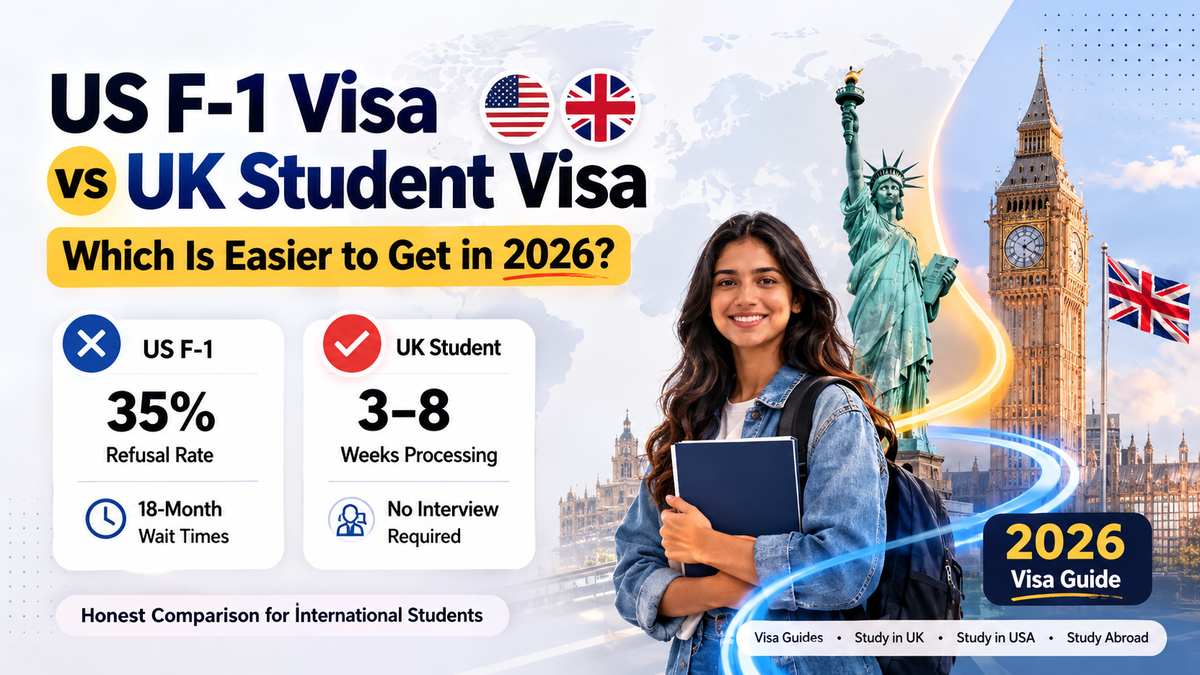
| Global refusal rate (2025) | 35% — highest in a decade | ~5–8% for most countries |
| Interview requirement | Mandatory in-person interview | No interview required |
| Appointment wait time | Up to 18 months (some countries) | Typically 3–8 weeks |
| Processing after interview | Days to weeks (if approved) | 3–8 weeks from application |
| Visa application fee | USD 185 (SEVIS) + USD 160 | GBP 490 + IHS (~GBP 776/yr) |
| Financial proof required | One full academic year of funds | 28 consecutive days of funds |
| Can defer if visa delayed? | Difficult — intake dependent | Easier — CAS valid 6 months |
Financial Requirements — What You Actually Need to Show
Both countries require you to prove you can fund your studies. But the way this is assessed differs significantly.
- USA — Full year funds, verified at interview: You must demonstrate funds covering your full first year of tuition plus living costs. For a private US university, this can mean showing USD 60,000–80,000+ in accessible funds. The visa officer at your interview will scrutinise this and may question the source of funds in detail. There is no minimum duration for which funds must be held, but a newly opened account or sudden large deposit will raise questions.
- UK — 28 consecutive days of bank statements: The UK requires you to show your funds have been held in your account for a minimum of 28 consecutive days before your application date. The required amount is the full course fee (first year only) plus £1,334/month for living costs (up to 9 months, or £1,023/month outside London). This is a clear, rules-based requirement that is significantly more straightforward to meet than the US equivalents.
- Sponsorship letters: Both countries accept financial sponsorship from a family member, employer, or government. The documentation requirements differ — the UK requires a specific format, while the USA allows more flexibility at the officer's discretion.
Post-Study Work Rights — Where the Real Difference Lies
The post-graduation story is where your destination choice has the most long-term impact on your career and life.
Which Visa Is Right for You?
- Choose the UK if: you need a visa within the next 3–6 months, you are not studying a STEM subject, you want open post-study work rights without a lottery, you are doing a one-year Masters and want to maximise time efficiency, or you cannot afford the financial uncertainty of a multi-year US visa wait.
- Choose the USA if: you are studying a STEM subject and can wait for a visa appointment, you have strong financial backing and a clear US employer target, you are willing to navigate the H-1B process for the chance of significantly higher long-term earnings, or you are targeting a specific top-ranked US research university with no UK equivalent.
- Consider applying to both: The smartest students in 2026 are applying to both simultaneously and committing to whichever visa arrives first. This removes the single biggest risk — losing your intake entirely to a processing delay in one country.
Frequently Asked Questions
Talk to Counselor Today