Australia Is Still Possible — But the Rules Have Fundamentally Changed
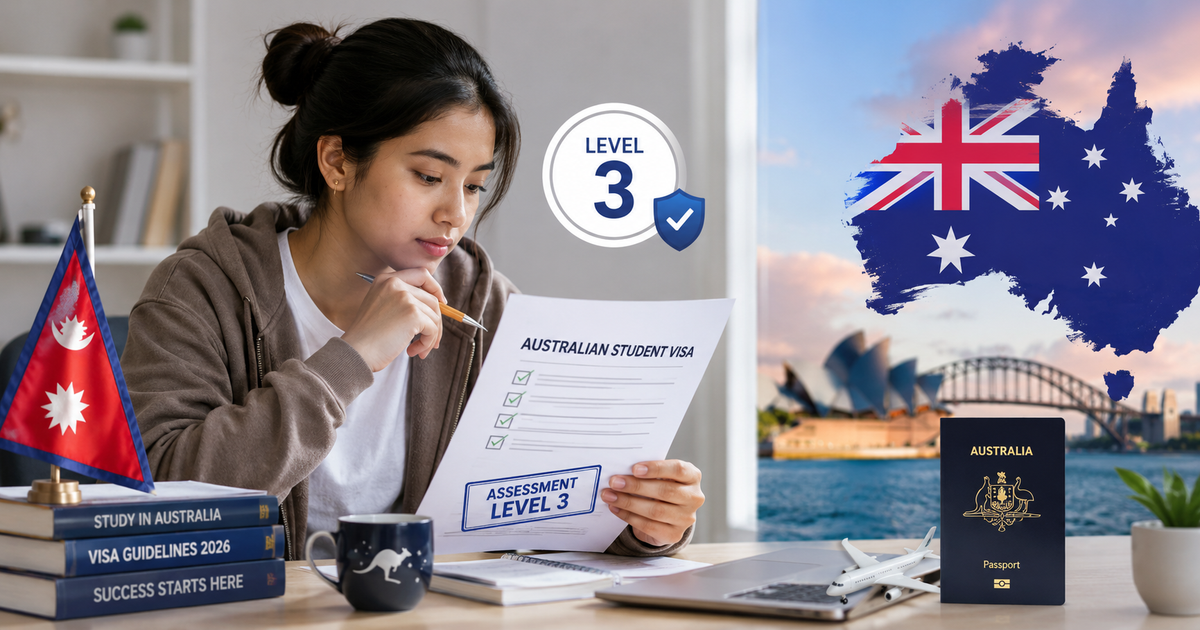
On 8 January 2026, the Australian Department of Home Affairs moved Nepal to Assessment Level 3 — the highest risk tier under its Simplified Student Visa Framework. By February 2026, Nepal's visa rejection rate had reached 65%, making it the top country for student visa refusals to Australia in the world. If you are planning to study in Australia, this is the most important update you need to understand before you apply for anything.
But here is what every panicking family needs to hear clearly: Assessment Level 3 does not mean Australia has closed its doors to Nepalese students. Thousands of Nepalese students are still receiving visas in 2026. The difference between approval and refusal is now almost entirely down to the quality and completeness of your application — not luck, not timing, not which consultancy you walk into.
What Exactly Changed Under Assessment Level 3
Under Level 2, Nepalese students could submit some supporting documents after lodging their visa application. Under Level 3, that flexibility is gone entirely. Your application must be complete, consistent, and fully evidenced at the time of submission. Anything missing will not be requested — your application will simply be refused.
| Requirement | Under Level 2 (Before Jan 2026) | Under Level 3 (Now) |
|---|---|---|
| Financial evidence | Could be submitted later | Must be submitted upfront, complete |
| English test scores | Optional for some applicants | Mandatory for almost all applications |
| Bank statement history | 3 months typical | Minimum 6 months, verified manually |
| GS / Genuine Student statement | General answers accepted | Personalised, detailed, cross-checked with SOP |
| Document verification | Largely automated | Manual case-officer review of every document |
| Processing time | 2–4 weeks typical | 4–12 weeks (longer for complex cases) |
The New Financial Requirements — Real Numbers
Under Assessment Level 3, financial documentation is no longer a formality. It is the single biggest deciding factor in your visa outcome. Case officers now manually verify every bank statement and cross-check fund sources. Understanding exactly what is required — and what will raise a red flag — is critical.
- Living costs — AUD 29,710 per year: This is the mandatory minimum for one student. You must demonstrate access to this amount in addition to your full first-year tuition fees and approximately AUD 2,000–4,000 in travel costs. Total funds typically required: AUD 55,000–65,000 (approximately NPR 60–70 lakhs) depending on your course.
- 6-month bank statement history: Funds must have been sitting in your account for a minimum of 6 months before your application date. Do not make large deposits shortly before applying — this is the most common reason for refusal under Level 3. Case officers are trained to spot sudden deposits and will flag them immediately.
- Education loan — from an A-Class bank only: If you are using an education loan, the sanction letter must come from a recognised commercial bank in Nepal (such as Nabil Bank, Himalayan Bank, Standard Chartered Nepal) and must explicitly state it covers both tuition fees AND living costs. A letter that covers only tuition fees is not sufficient under Level 3 requirements.
- Clear source of funds: You must document exactly where your money comes from — salary slips, business audit reports, tax clearance certificates, or property sale documents with a clear paper trail. Property valuation certificates alone are not accepted. Australia requires liquid funds, not asset value.
- No sudden large deposits: If your bank balance exactly meets the minimum requirement with no margin, or if a large sum appeared recently without explanation, your application is at significantly higher risk of refusal. Aim to show 10–15% above the minimum threshold, with a clear and consistent funding history.
The Genuine Student Statement — The Most Common Reason for Refusal
Australia replaced the old GTE (Genuine Temporary Entrant) test with the new Genuine Student (GS) requirement in 2025. Under Level 3, your GS statement is not a formality — it is your only direct opportunity to speak to the case officer reviewing your application. A generic, template-based, or AI-generated GS statement is one of the leading causes of visa refusal in 2026.
Your GS statement must answer four things clearly and specifically:
- Why this specific course? Explain the direct connection between your academic background and the course you are applying for. A BSc Computing graduate applying for an IT Masters has a clear story. A management student applying for a low-level vocational diploma in an unrelated field will face serious scrutiny without a convincing explanation.
- Why Australia — and why this specific institution? Generic answers such as "Australia has great universities" will be flagged immediately. Reference specific features of the course, the institution's industry connections, or how the qualification is recognised in your career field in Nepal.
- What are your career plans after graduation? Your stated career goals must be realistic, Nepal-focused, and connected to what you are studying. Writing goals that imply you intend to stay in Australia permanently rather than return — even subtly — increases your refusal risk significantly.
- What are your ties to Nepal? Family, community, professional, and financial ties to Nepal all strengthen your GS statement. Case officers are looking for evidence that you have genuine reasons to return home after your studies.
English Score Requirements Are Now Mandatory
Under Assessment Level 2, some Nepalese students could apply for an Australian student visa without submitting English test results. Under Level 3, English proficiency scores are mandatory for almost all applications. Submitting a Medium of Instruction (MOI) certificate from your Nepali university is not a valid substitute under Level 3 requirements.
- IELTS Academic: Minimum 6.0 overall with no individual band below 5.5 for university programmes. A score of 6.5 overall is significantly safer under Level 3 scrutiny.
- PTE Academic: Minimum overall score of 50, with no section below 42. A score of 58+ is recommended for Level 3 applications.
- TOEFL iBT: Minimum 79 overall. Check your specific institution's requirements as some programmes require higher scores.
- Score validity: Your English test result must be no more than two years old at the time of your visa application — not your course start date. A December 2023 IELTS score is invalid for a visa application lodged after December 2025.
Your University Choice Now Directly Affects Your Visa Outcome
Under Australia's Simplified Student Visa Framework, your total visa risk is calculated by combining two factors: your country's risk level and your chosen education provider's risk level. Nepal is now Level 3. This means your choice of university or college has a direct mathematical impact on how strictly your application is assessed.
- Apply to a Level 1 university where possible: Group of Eight universities (University of Melbourne, ANU, University of Sydney, UNSW, Monash, University of Queensland, University of Western Australia, University of Adelaide) and most major public universities are Level 1 providers. Combining Level 3 country + Level 1 university lowers your combined risk and can result in smoother processing.
- Avoid low-compliance private colleges: Applying to a Level 2 or Level 3 private college from a Level 3 country results in the maximum possible scrutiny. Many of these rejections are not because the student is not genuine — they are because the application cannot survive the combined risk assessment.
- Consider regional universities: Institutions in Adelaide, Perth, Hobart, and Darwin are typically Level 1 providers with significantly lower tuition fees than Sydney or Melbourne. They also offer 5 extra PR points for studying and working in a regional area after graduation.
How to Build a Successful Application Under Level 3 — Step by Step
- Choose the right course and institution — 4–6 months before intake Select a course with a clear logical connection to your academic background. Apply to a Level 1 provider where possible. Check the institution's visa approval track record — your consultancy should be able to advise on this.
- Start your financial preparation immediately Begin building or documenting your bank balance at least 6 months before your intended visa lodgement date. Do not make sudden large deposits. Ensure your education loan sanction letter covers both tuition and living costs if you are using a loan.
- Book and complete your English test early Do not leave your IELTS or PTE until the last moment. Aim for 6.5 IELTS or 58 PTE to give yourself a comfortable margin above the minimum. Retakes take time and can delay your entire application timeline.
- Write your SOP and GS statement together Draft both documents at the same time to ensure they are consistent. Your career goals, your reasons for choosing Australia, and your ties to Nepal must align exactly across both documents. Contradictions between these two are the single most common cause of refusal.
- Prepare a decision-ready, complete application Under Level 3, your application must include every required document at the moment of lodgement. Check the Document Checklist Tool in ImmiAccount for your specific combination of country level and institution level. Lodge at least 8 weeks before your course start date to allow for processing time.
- Work with an experienced, ethical consultancy Under Level 3, the margin for error is zero. Professional guidance from a consultancy that understands the current requirements is no longer optional — it is the most effective single thing you can do to protect your application outcome.
Frequently Asked Questions
Talk to Counselor Today