The USA Is Still World-Class — But No Longer the Safe Default
For decades, the United States was the automatic first choice for international students. The best universities, the biggest salaries, the most prestigious degrees. But 2025 changed the conversation — and 2026 is forcing students and families to think harder than ever before about whether the USA is still the right decision.
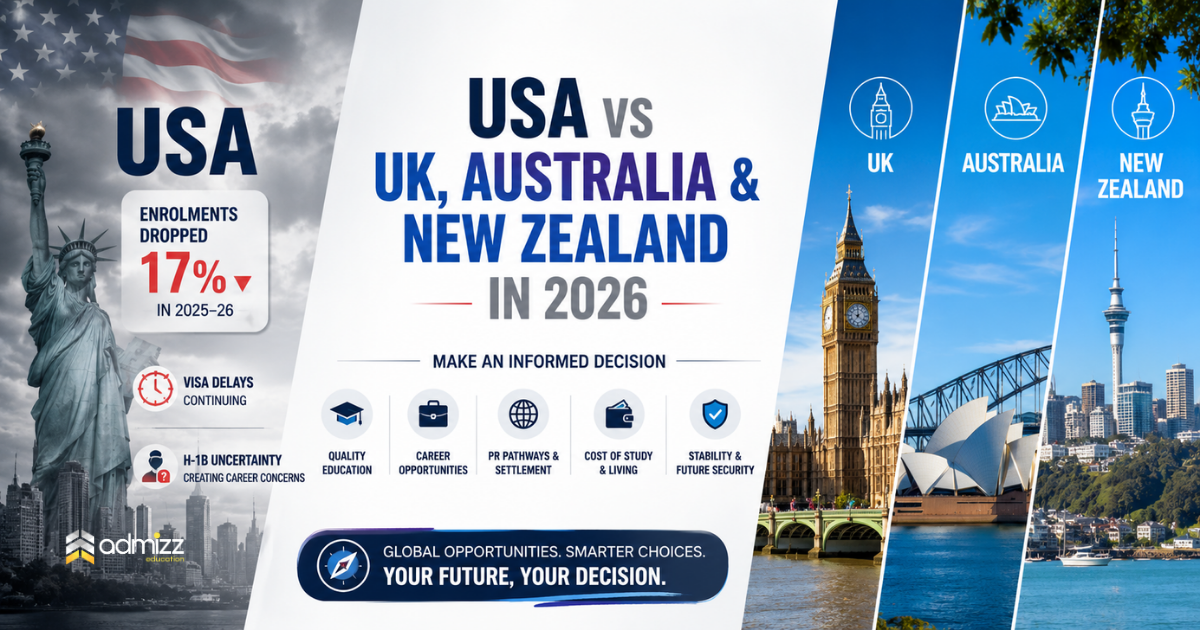
International student enrolments at US universities fell by 17% in 2025–26 — the steepest drop in a generation. Visa interview wait times have stretched to 18 months in some countries. OPT and STEM OPT face ongoing policy uncertainty. And the H-1B lottery, the primary route from US graduate to long-term US resident, rejects roughly 70% of applicants each year.
Where the USA Is Still Unbeatable
The honest truth is that for certain students with certain goals, no other country comes close.
- Highest graduate salaries in the world: STEM graduates from well-ranked US universities regularly start at USD 80,000–110,000 per year — no other English-speaking country matches this ceiling, particularly in technology and finance.
- STEM OPT — 3 years of work authorisation: If your course qualifies as STEM, you receive 12 months of standard OPT plus a 24-month extension — the longest post-study work window of any major destination for science and tech graduates.
- World-leading universities: MIT, Stanford, Harvard, Carnegie Mellon — the top of the global rankings is dominated by US institutions. For research, innovation, and brand recognition, the US remains unmatched.
- Unrivalled industry access: Silicon Valley, Wall Street, Boston's biotech cluster — the world's highest concentrations of leading employers are in the USA.
The Honest Challenges in 2026
- Visa delays: Interview wait times of 12–18 months in high-demand countries are forcing students to defer admissions or switch destinations. In May 2026, 31 higher education associations wrote to the State Department urging prioritisation of student visa processing.
- H-1B uncertainty: The H-1B lottery selects roughly 85,000 visas from over 400,000 applications — a ~30% hit rate that is largely random. Even strong candidates from top schools can go unselected for multiple years.
- Non-STEM graduates are exposed: If your course is not STEM, post-study work is limited to just 12 months of OPT with no extension and no PR pathway through work alone.
- High costs: Annual tuition at private US universities ranges from USD 50,000–80,000. Combined with living costs in major cities, total annual spend can exceed USD 100,000.
How the USA Compares to Your Alternatives
The smartest students in 2026 compare destinations honestly and apply to whichever gives them the best combination of course quality, visa certainty, post-study work, and PR pathway.
Frequently Asked Questions
Talk to Counselor Today