Quick Answer
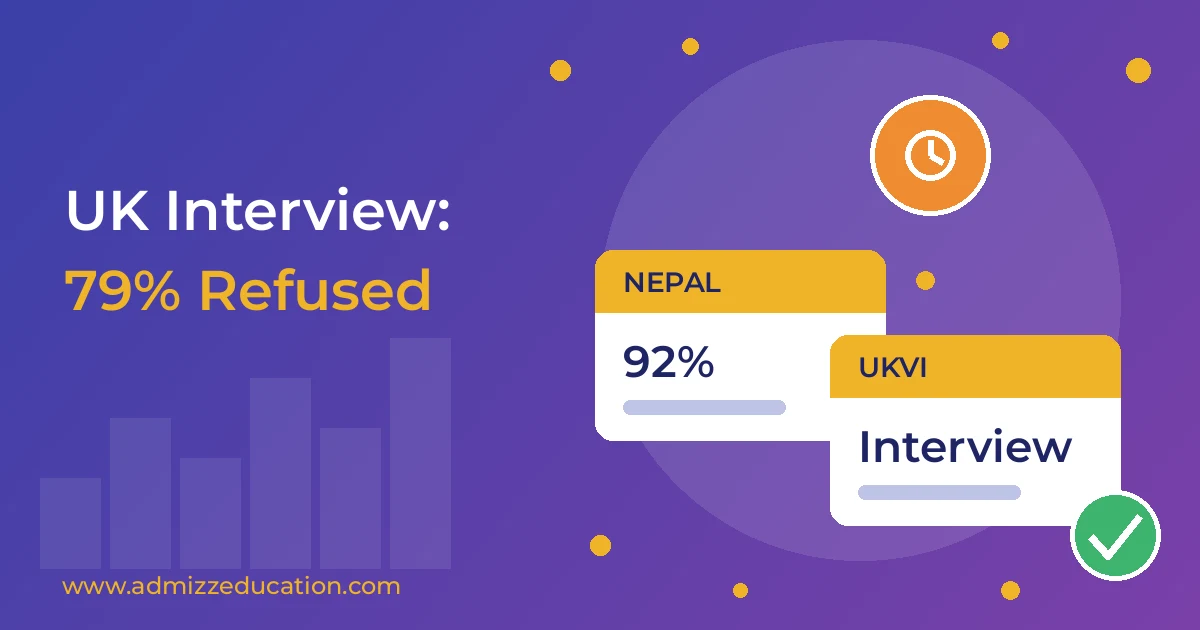
The PIE News reported on November 18, 2026 that UKVI judged 9,043 of 11,415 credibility interviews (79%) between May and October 2026 as non-credible, and that 92% of interviewed Nepali students were rejected. This comes from a UKVI briefing paper seen by The PIE, not a published statistic, and UKVI said the six-month data may not represent a full year.
What did the UKVI interview data show?
The PIE News reported on November 18, 2026 that UKVI rejected 79% of prospective students called to a credibility interview in a six-month period. Of 11,415 interviews conducted between May and October 2026, 9,043 were considered by UK case officers to be non-credible.
The figures come from a UKVI study sector briefing paper obtained by The PIE. The article gives no link to the paper, and it is not an official published statistic. The headline says 80%, but the body figure is 79% (9,043 divided by 11,415 is about 79.2%), so we use 79%.
How many Nepali students were refused after interview?
The article's nationality breakdown lists the share of interviewed students rejected:
| Nationality | Judged non-credible | Share of interviewed students rejected |
|---|---|---|
| Nepal | 622 | 92% |
| India | 1,558 | 89% |
| Nigeria | 2,750 | 84% |
| Bangladesh | 1,006 | 79% |
| Sri Lanka | 370 | 78% |
| Pakistan | 1,418 | 73% |
The article's text gives Sri Lanka as 79%, but its table says 78%, so we use the table. Read this carefully. It is the share of students who were interviewed, not the share of all Nepali applicants. The article does not say how many Nepali students were interviewed, and UKVI stressed that the data covers only six months and is not necessarily representative of a full year.
Why were students refused after the interview?
The PIE reports these reasons for credibility refusals between May and October 2026, as advised by UKVI:
- Lack of research about the chosen institution.
- Not being able to clearly explain why they chose to study in the UK, and how the institution and program align with their future plans.
- Lack of knowledge about the chosen program or subject.
- English language ability.
- Credibility of funds.
This is UKVI's account as relayed by The PIE, not official GOV.UK guidance. The article also quotes a Home Office official saying about 6,000 students were interviewed during the summer period and that there has been a high refusal rate among those interviewed.
What does the Home Office guidance say about the interview?
The Home Office's Student and Child Student caseworker guidance (version 15.0, published for Home Office staff on October 9, 2026) sets out the genuine student rule:
- A caseworker must be satisfied, on the balance of probability, that the applicant is a genuine student. They look at everything in the application and, if there is one, the credibility interview.
- A caseworker must not refuse on genuineness grounds without interviewing the applicant, with two exceptions: a previous refusal on genuine student grounds with no change in circumstances or new evidence, or a significant number of identical or very similar applications where a sample has been interviewed.
- For applications made outside the UK, an Entry Clearance Officer must refer to an Entry Clearance Manager to authorize the interview, and the manager takes account of risk factors. The guidance does not publish those risk factors.
- An applicant who fails to attend an interview without a reasonable explanation can be refused.
- A refusal on credibility grounds must set out the caseworker's reasoning, and the refusal letter must reflect the interview transcript.
The factors caseworkers must consider are not an exhaustive checklist. They include immigration history, education history and study plans (including the applicant's knowledge of and research into the course, the institution and living arrangements), whether the course fits post-study plans, a credible source of funds and how the applicant acquired them, English ability, concerns about an agent managing the application, and whether the main reason is benefits for dependants. Caseworkers must not refuse an applicant for not knowing local details such as bus routes or the geography of the town.
How can Nepali applicants prepare?
The steps below are our advice, built from the reasons above. They are not official instructions.
- Know your university and course. Be able to name modules, how the course is taught and why that university fits you.
- Explain why the UK, in your own words, and how the course connects to your plans after you graduate.
- Be ready to show English ability in a normal conversation, not only through a test score.
- Explain your funds. Know who is paying, where the money came from and how it was acquired, because the guidance lists this as a factor. See how much bank balance you need for a UK student visa.
- Keep your statement of purpose consistent with what you say. Our SOP guide shows how.
For the wider picture, read why student visas get refused and the UK student visa guide for Nepal.
What could we not confirm?
The guidance does not say why Nepali applicants are interviewed so often, and the risk factors used to authorize interviews are not published. We also could not confirm The PIE's figures against an official statistic, because they come from a UKVI briefing paper. If you receive an interview invitation, rely on the instructions in your invitation and on GOV.UK. If you want help planning your application, book a free consultation.
Frequently Asked Questions
What share of UK credibility interviews ended in refusal?
The PIE News reports UKVI judged 9,043 of 11,415 interviews (79%) between May and October 2026 as non-credible. The figure comes from a UKVI briefing paper, not a published statistic.
What share of Nepali students were rejected after interview?
The same report lists 92% of interviewed Nepali students as rejected. That is the share of students interviewed, not of all Nepali applicants.
Why do students fail the UK credibility interview?
Reasons reported include weak research about the institution, unclear reasons for choosing the UK and course, limited program knowledge, English ability and doubts about funds.
Is the 79% figure official?
No. It comes from a UKVI briefing paper obtained by The PIE News. UKVI said the six-month data is not necessarily representative of a full year.
The interview figures are second-hand: The PIE's report of a UKVI briefing paper. The rules come from the Home Office guidance above, read from the PDF published for staff. Check GOV.UK for the current version. This guide was checked in November 2026.
Sources
The facts in this guide come from the official pages below. Open them to confirm the latest details before you apply.
- thepienews.comThe PIE News, November 18, 2026: UKVI rejects 80% of students called to interview as visa refusals surge
- gov.ukGOV.UK: Student and Child Student caseworker guidance (accessible), version 15.0, published for Home Office staff on October 9, 2026
- gov.ukGOV.UK: Student visa overview
📅 Checked in November 2026. Rules change, so confirm on the official site before you apply.
Book a Free Consultation