Quick Answer
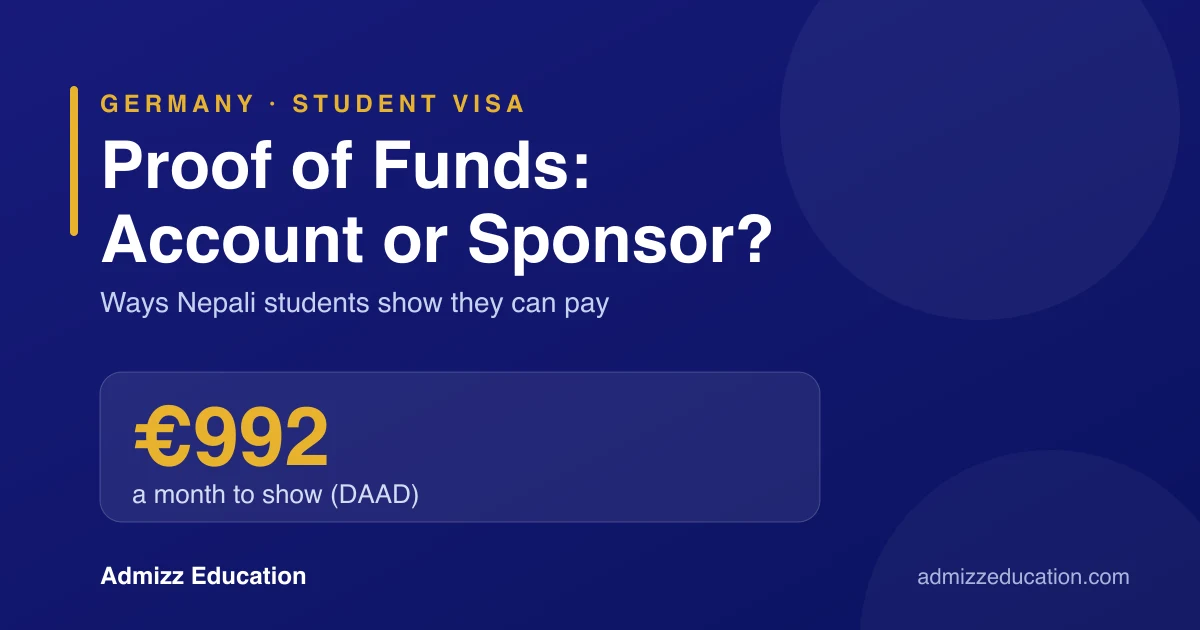
For a Germany student visa you can prove funds with a blocked account, a sponsor's declaration of commitment (Verpflichtungserklärung), a scholarship, your parents' income or a bank guarantee. DAAD lists 992 euros per month as of January 1, 2025, and the amount depends on your purpose of stay. The embassy makes the final decision.
How do you prove funds for a Germany student visa from Nepal?
You have to show the German authorities that you can pay for your studies and daily life in Germany. The Federal Foreign Office lists five ways to do this, according to its guidance on financing a student visa:
- Your parents' income and financial situation.
- A declaration of commitment (Verpflichtungserklärung) signed by a person with enough income or assets.
- A blocked account (Sperrkonto) in Germany.
- A bank guarantee from a bank in Germany.
- A scholarship that covers your stay.
The German Embassy in Kathmandu names its own list in its student visa checklist: a scholarship or stipend confirmation, a formal sponsorship letter from a sponsor living in Germany, proof of financial status, or a blocked account. The embassy adds that a blocked account "is not mandatory for applying but may be requested during the visa process."
The amount depends on your purpose of stay. DAAD says you must prove 992 euros per month as of January 1, 2025. The final decision on your visa is made by the embassy, not by your university or by a consultancy.
Germany student visa financial proof Nepal: the options compared
Here is a plain-words comparison. Which option the embassy will accept in your case is its decision, so treat the "who it suits" column as a starting point.
| Option | What it is | Who it suits | What to check |
|---|---|---|---|
| Blocked account (Sperrkonto) | Money you deposit in a blocked account in Germany. You can only withdraw a set amount each month. | Students who pay for their studies from family savings and have no sponsor in Germany. | The amount for your purpose of stay, bank fees, and the account beneficiary. |
| Declaration of commitment (Verpflichtungserklärung) | A formal promise by a person in Germany to pay your costs, signed at the foreigners authority (Ausländerbehörde). | Students with a relative or friend in Germany who has enough income and agrees to the legal duty. | Whether the sponsor's income is enough, and the time limit between signing and your visa. |
| Scholarship | Funding from a public or recognized German source that covers your stay. | Students who have already won a scholarship that covers living costs. | That the scholarship letter says what it covers and is from a body the Foreign Office recognizes. |
| Parents' income | Documents on your parents' income and financial situation. | Students whose family can show regular, documented income. | Which documents the embassy wants and how recent they must be. |
| Bank guarantee | A guarantee deposited with a bank in Germany, renewed every year. | Students whose family prefers a guarantee to a one-time deposit. | Which banks offer it and the yearly renewal. |
For the blocked account amount itself, read our guide to the blocked account for Nepali students and the short answer on the blocked account amount.
What is a blocked account (Sperrkonto) and who is it for?
A blocked account holds your money so that you cannot spend it all at once. The Federal Foreign Office says the account must hold enough to cover the costs of daily life in Germany, and that only a set amount can be withdrawn each month. See its blocked account page for details.
- Where to open it: at a bank or similar provider of your choice. Accounts can usually be opened online.
- How long: usually for one year, unless your planned stay is shorter.
- Account beneficiary: you must name one. Before the visa is granted or used, it is the mission abroad where you applied. After you arrive, it is the foreigners authority. The beneficiary cannot withdraw your money.
- Fees: you pay banking fees on top of the blocked amount. The Foreign Office makes no recommendation of providers, so research the conditions yourself.
- Other proof can lower the amount: the Foreign Office says you may present other proof of support in addition to the account, which can reduce the credit required.
DAAD adds that the money cannot be accessed until you enter Germany and that documents must be certified by a German diplomatic mission in your home country before you submit them to a bank. Ask the embassy in Kathmandu whether that step applies to the bank you choose.
The blocked account suits you if the money comes from your family and nobody in Germany can sign for you. For the amount, see our proof of funds guide.
What is a declaration of commitment (Verpflichtungserklärung) for a student visa?
A declaration of commitment is a written promise by a person to pay for your living costs in Germany. It falls under Articles 66 to 68 of the German Residence Act (Aufenthaltsgesetz), according to the Federal Foreign Office.
How it works, per official pages:
- Who issues it: the sponsor, usually at the foreigners authority (Ausländerbehörde) where they live, according to the Federal Foreign Office. The office checks the sponsor's creditworthiness and certifies the signature.
- What it covers: all costs that arise from your stay in Germany, including living costs and medical treatment.
- Time limit: in general, no more than 6 months should pass between the declaration and the visa being issued, because the sponsor's finances can change. After that, a new declaration is usually needed.
- How long the sponsor is liable: five years, starting when you enter Germany on the strength of the declaration, according to Section 68 of the Residence Act. The sponsor must repay public funds spent on your living costs.
- If the sponsor's income is too low: the sponsor can still sign, but the German mission will not recognize the declaration, according to Service Berlin.
- Fee: it is set by each city. Berlin charges 29 euros for an adult or couple, according to Service Berlin. Ask the sponsor's local office for its own fee.
This option suits students with a close relative or friend in Germany who has regular income and understands the legal duty. The sponsor is liable for years, so it is a serious commitment, not a favor on paper. The embassy checklist calls it a "formal sponsorship letter from a sponsor living in Germany."
Can a scholarship, parents' income or a bank guarantee prove funds?
Scholarship. The Federal Foreign Office says funding is considered proven if a scholarship covers your stay. That includes public-funded scholarships, scholarships from a recognized German organization, and public-funded scholarships from your home country, where the Federal Foreign Office, DAAD or another German scholarship body connected you with a German university. DAAD lists "proof of receipt of a recognized scholarship" as accepted proof. The embassy also notes that you are exempt from the visa fee if you have a scholarship. If your scholarship covers only part of your costs, ask the embassy how to show the rest.
Parents' income. The Foreign Office and DAAD both list your parents' income as accepted proof. The Kathmandu checklist calls this "proof of financial status" and does not say which documents it wants, so ask the embassy.
Bank guarantee. The Foreign Office lists a bank guarantee from a bank in Germany, renewed every year. The Kathmandu checklist does not mention it, so confirm with the embassy before you plan around it.
One document may not be enough. The embassy reserves the right to ask for additional documents or an additional interview, and refusing to appear for an interview may lead to your application being rejected.
What should you ask the German Embassy in Kathmandu before applying?
Because the embassy decides, confirm these points with it before you transfer money or ask a sponsor to sign:
- Which method do you accept for my degree and purpose of stay? The amount depends on your purpose of stay.
- Do you want the blocked account now or only if requested later? The checklist says it may be requested during the visa process.
- Does my sponsor's declaration need to meet any income level? The mission does not recognize a declaration if the sponsor's income is too low.
- Which parents' income documents do you want?
- Is my scholarship letter enough, and does it exempt me from the visa fee?
- Do I need anything else? Ask about extra documents and the interview.
Good to know: the embassy lists a visa fee of 75 euros, paid in Nepali rupees in cash, and a minimum processing time of about 3 to 4 weeks. Apply early and keep your proof ready.
Plan the rest of your budget with our Germany costs and intakes guide and the study in Germany page. Admizz Education is a consultancy that offers free consultation and admission and visa support. You can register for a free consultation.
Checked in November 2026: what to re-check
Checked in November 2026 against the official pages listed below.
Re-check these before you apply, because rules, forms and amounts can change:
- The monthly amount: DAAD's costs of education and living page, plus the embassy's own figure.
- The accepted documents and checklist: the German Embassy Kathmandu student visa page.
- The declaration fee and rules: the foreigners authority where your sponsor lives.
To see other deadlines and rule changes, read our rule changes calendar.
Frequently Asked Questions
Sources
Every figure in this guide comes from the official pages below. Open them to confirm the latest details before you apply.
- auswaertiges-amt.deFederal Foreign Office: When applying for a student visa, how can I prove that my financing is secure?↗
- kathmandu.diplo.deGerman Embassy Kathmandu: Study Visa↗
- kathmandu.diplo.deGerman Embassy Kathmandu: Opening and closing a blocked bank account (Sperrkonto)↗
- daad.deDAAD: Costs of education and living↗
- auswaertiges-amt.deFederal Foreign Office: Informationen zur Verpflichtungserklärung↗
- gesetze-im-internet.deGesetze im Internet: Section 68 Residence Act (AufenthG)↗
- service.berlin.deService Berlin: Verpflichtungserklärung abgeben↗
Book a Free Consultation