Study permit fee
CAN$150 per person
Biometrics fee
CAN$85 per person, maximum CAN$170 for a family applying together
Living-cost proof for one applicant (applications from September 1, 2026)
CAN$23,448 per year, plus first-year tuition and travel costs
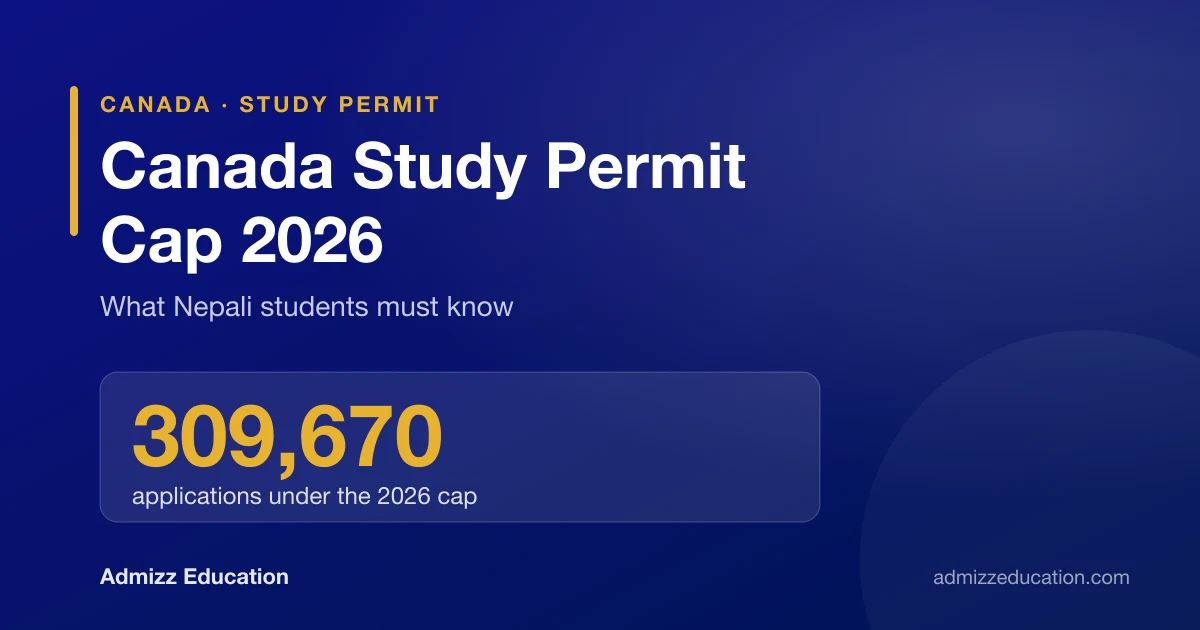
2026 national cap
309,670 application spaces for students who need a PAL/TAL
PGWP language level
CLB 7 for degree programs, CLB 5 for college programs
Quick Answer
For a study permit application made on or after September 1, 2026, IRCC asks a single applicant to show CAN$23,448 for living costs, plus first-year tuition and travel. The permit costs CAN$150 and biometrics CAN$85. Most students also need a provincial attestation letter.
The fees you pay IRCC
Two government fees apply to almost every Nepali student.
- Study permit fee: CAN$150 per person.
- Biometrics fee: CAN$85 per person. If two or more family members apply together, the maximum is CAN$170.
Both are in Canadian dollars, and you pay them when you submit your application. Fees can change, so always confirm on the IRCC fee list before paying.
These fees are small compared with tuition and living costs. The bigger question is how much money you must prove you have.
A simple way to plan is to split your costs into three groups. First, the one-time government fees above. Second, first-year tuition, which your school sets. Third, living costs for the year, which IRCC sets as the minimum you must show. Add travel costs to and from Canada on top.
Write these three numbers down before you shortlist schools. It helps you compare programs honestly and avoid surprises close to your application date.
Proof of funds: how much you must show
IRCC asks you to show you can pay for three things: your first year of tuition, your living costs, and transport to and from Canada for you and any family members who come with you.
For living costs, IRCC lists a yearly amount (not including tuition or transport) based on family size. For a single applicant:
- Applications from September 1, 2026: CAN$23,448 per year.
- Applications between January 1, 2025, and August 31, 2026: CAN$22,895 per year.
For two people the new figure is CAN$29,192, and for three it is CAN$35,888. IRCC publishes the full table up to seven family members.
IRCC does not set one fixed tuition figure. You show a receipt or proof of what your chosen school charges for the first year. Tuition differs by school and program, so we do not quote a range here. Check your school's fee page and your offer letter.
Students applying to Quebec follow the amounts set by the Quebec government, so check that process separately.
If your spouse or children come with you, the living-cost amount goes up with each person. Plan the total early, because gathering funds and proof of where they came from can take time. Our Canada study guide explains the wider process step by step.
Where a GIC fits in
A GIC (guaranteed investment certificate) is a deposit you make with a Canadian financial institution. IRCC lists a GIC as one example of acceptable proof of funds.
The amount of your GIC should match the living-cost figure above for your family size. IRCC does not name a specific GIC amount for Nepal, so confirm the exact deposit with the bank that issues your GIC and on the IRCC proof-of-funds page.
A GIC is one way to show money. It is not the only way. Bank statements and other proof listed by IRCC can also count, but your funds must be clear and genuine. Nepali students apply through the regular process.
Ask your bank how long it takes to open the account and issue the GIC certificate, and keep every receipt. Start early so a delay at the bank does not hold up your application.
Attestation letter and the 2026 cap
Most students applying to a designated learning institution outside Quebec need a provincial or territorial attestation letter (PAL/TAL) with their study permit application. In most cases your school issues it after you accept your offer and pay tuition, in part or in full.
The national cap for 2026 is 309,670 application spaces. It applies to students who need a PAL/TAL. IRCC expects to issue up to 408,000 study permits in 2026 in total, including extensions.
You do not need a PAL/TAL for some groups, including master's and doctoral students at public institutions from January 1, 2026, and primary and secondary students.
A PAL/TAL issued in 2026 is valid until December 31, 2026, and you cannot use one issued in a previous cap year. Students going to Quebec need a Quebec Acceptance Certificate (CAQ) instead.
For more detail, read our guides on the 2026 study permit cap and the PAL requirement.
PGWP rules after you graduate
The Post-Graduation Work Permit (PGWP) lets some graduates work in Canada. Key rules from IRCC:
- Your program must be at least 8 months long (900 hours for Quebec programs).
- You must have studied full-time in each semester, except that part-time is allowed in your final semester.
- Language: CLB 7 for bachelor's, master's and doctoral degrees and other university programs. CLB 5 for college, polytechnic and other non-university programs.
- Field of study: no field requirement for bachelor's, master's or doctoral degrees. For other programs, you must graduate in an eligible field if you applied for your study permit on or after November 1, 2024.
- Apply within 180 days of confirmation that you completed your program, and your study permit must have been valid at some point in those 180 days.
The length of the PGWP follows the length of time you studied in Canada. IRCC's page does not give a separate PGWP fee, and the general work permit fee is CAN$155, so check IRCC for the fee that applies to you.
Choosing a program with these rules in mind matters before you pay your deposit. See our Canada study guide for Nepali students for more on programs and intakes.
Check before you apply
- Confirm the proof-of-funds amount for your family size on the IRCC page on the day you apply. The amount rose on September 1, 2026.
- Ask your school whether your program needs a PAL/TAL or is exempt.
- Check that your program and school are eligible for a PGWP, and your field of study if it is not a degree.
- Ask your GIC bank for the exact deposit amount and timeline.
- Keep proof of tuition payment and travel funds ready.
- Do not rely on old figures from 2025 pages or social media posts.
If you want a second pair of eyes on your documents, our counseling team can walk through them with you.
Sources
- IRCC: Proof of financial support
- IRCC: Fee list
- IRCC: Study permit, get the right documents
- IRCC: Provincial and territorial attestation letter
- IRCC: 2026 provincial and territorial allocations under the international student cap
- IRCC: PGWP eligibility
Checked in October 2026. Rules change, so confirm on the official site when you apply. For help with your own application, talk to our counseling team.
Frequently Asked Questions
How much does a Canada study permit cost?
The study permit fee is CAN$150 per person. Biometrics cost CAN$85 per person, with a maximum of CAN$170 for a family applying together.
How much living-cost money must I show for one person?
For applications made on or after September 1, 2026, IRCC lists CAN$23,448 per year for one applicant, on top of first-year tuition and travel costs. For applications from January 1, 2025, to August 31, 2026, the figure was CAN$22,895.
Do I have to buy a GIC?
IRCC lists a GIC from a Canadian financial institution as one example of acceptable proof of funds. Check the exact deposit amount with the issuing bank and on the IRCC page.
Do I need a provincial attestation letter?
Most students applying outside Quebec do, and it is usually issued by your school after you accept your offer and pay tuition. Master's and doctoral students at public institutions are exempt from January 1, 2026. Quebec uses a CAQ.
What language level do I need for a PGWP?
CLB 7 for degree programs and other university programs, and CLB 5 for college and other non-university programs.
Book a Free Counseling Session