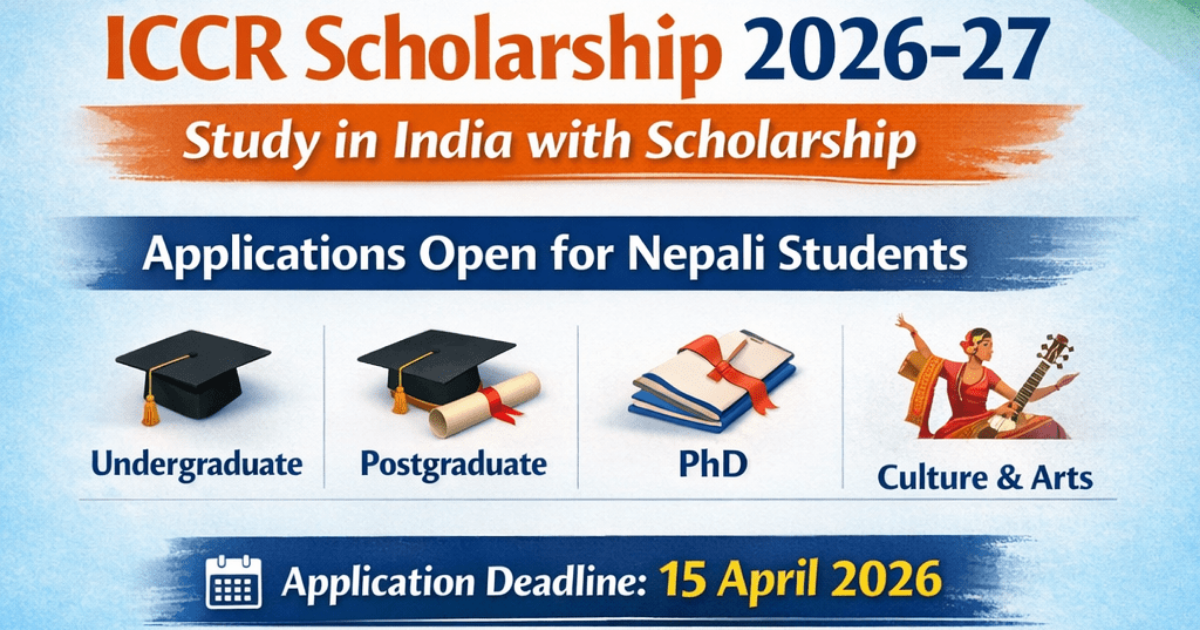
The Indian Council for Cultural Relations (ICCR) has opened applications for the ICCR Scholarship 2026–27 for Nepali students who wish to pursue higher education in India. These scholarships provide an excellent opportunity for students to study at recognized Indian universities and institutions with financial support.
If you are planning to study in India with a scholarship, this guide explains the available schemes, eligibility, application process, and important deadlines.
ICCR Scholarship Schemes for 2026–27
The Embassy of India in Kathmandu invites applications from Nepali students under the following scholarship schemes:
Atal Bihari Vajpayee General Scholarship Scheme
Available for students pursuing Undergraduate programs in India.
Sushma Swaraj Silver Jubilee Scholarship Scheme
Supports students pursuing Postgraduate and doctoral (PhD) programs at Indian universities.
Lata Mangeshkar Dance & Music Scholarship Scheme
Designed for students interested in Indian culture and performing arts.
Students applying under the Lata Mangeshkar scheme may be required to provide evidence of prior knowledge or experience. Eligible performing art disciplines include:
- Dance
- Music
- Theater
- Sculpture
- Indian languages
- Yoga
- Indian cuisine
Important Dates
Students are encouraged to apply early and carefully review all instructions before submitting the application.
How to Apply for ICCR Scholarship
Students must apply online through the ICCR A2A Scholarship Portal. Applicants should carefully read the guidelines and fill out the online application form with accurate information.
Application Fee
Documents Required for Application
Students should prepare the following documents before applying:
- Academic transcripts and certificates (Class 10 and 10+2 or higher)
- Passport copy
- Passport-size photograph
- English translation of documents if the originals are not in English
- A 500-word essay in English on a topic provided on the portal
- Proof of English proficiency or an undertaking from the last attended institution
Students should ensure all documents are complete and properly uploaded, as incomplete applications may be rejected.
Age Criteria
Applicants must meet the following age requirements as of July 1, 2026:
| Program Level | Min Age | Max Age |
|---|---|---|
| Undergraduate | 18 years | 35 years |
| Postgraduate | 18 years | 35 years |
| PhD / Doctoral | 18 years | 40 years |
| Cultural courses | 18 years | No upper limit* |
*Some cultural courses may not have an upper age limit, depending on the institution.
Important Notes for Applicants
Final Thoughts
With proper preparation and timely application, students can benefit from this prestigious scholarship and gain international academic exposure.
If you are interested in applying for the ICCR Scholarship 2026–27, make sure to prepare your documents early and submit your application before the deadline. If you need any more guidelines, please connect with Team Admizz Education!