
The Question Every Nepali Family Is Asking in 2026
Every year, over 100,000 Nepali students make one of the most consequential decisions of their lives: which country to study in. And in 2026, that decision is more nuanced — and more consequential — than ever before.
The landscape for Nepali students studying abroad has shifted dramatically in the past 12 months. Australia moved Nepal to Assessment Level 3 in January 2026, raising the documentation bar significantly. Canada cut its new-arrival study permits by nearly 50% — yet simultaneously exempted master's and PhD students from the cap entirely. The UK retained its popular Graduate Route but tightened dependent visa rules. Japan welcomed Nepal as its second-largest international student cohort. Germany continues to offer tuition-free education at public universities. Each of these changes reshapes what is possible, affordable, and practical for Nepali students this year.
The truth is, there is no single "best" country for every Nepali student. The right answer depends entirely on your academic level, budget, career goals, English proficiency, family situation, and long-term plans. What this guide does, however, is give you the clearest, most current picture available — so you can make that choice with real information rather than hearsay.
🇦🇺 Australia
Australia remains the undisputed number one study destination for Nepali students — with over 59,000 currently enrolled — and that position is unlikely to change in 2026. Level 3 means stricter financial documentation (3–6 months of clean bank statements), mandatory English proficiency scores, a more personal Genuine Student (GS) statement, and an increased likelihood of an interview with a case officer. Processing time has extended to 4–12 weeks.
Importantly, Australia increased its 2026 National Planning Level (NPL) to 295,000 international student places — 25,000 more than 2025 — signalling clearly that the country is not closing its doors. Genuine, well-prepared applicants continue to receive approvals.
Nepali students who want a combination of world-class degrees, strong PR pathways, and the largest Nepali community abroad. Regional study in Adelaide, Hobart, or Canberra offers an extra year of post-study work rights and bonus PR migration points — making it the smartest strategic choice in 2026 for students with long-term residency goals.
🇨🇦 Canada
Canada has introduced the most significant policy shift benefiting graduate-level Nepali students in years. Together, these changes make Canada arguably the most attractive destination specifically for graduate-level students in 2026.
That said, there is crucial nuance for undergraduate students. The 2026 cap allows just 155,000 new study permits — down nearly 50% from 2024 — and competition for provincial attestation letters (PALs) from Ontario and British Columbia is intense. Toronto and Vancouver now rank among the world's most expensive cities for international students.
Nepali students pursuing master's or PhD degrees who want the fastest and most clearly structured route to permanent residency. Canada's Express Entry system, combined with the new graduate exemption and a 3-year PGWP, gives graduate-level Nepali students a genuinely competitive PR pathway — arguably the best available anywhere — in 2026.
🇬🇧 United Kingdom
The UK remains a compelling destination — particularly for Nepali students pursuing a master's degree. One of the UK's clearest advantages is that most master's programs are just one year long, significantly reducing both tuition costs and time away from Nepal. The Graduate Route allows students to remain in the UK to work for 2 years after a bachelor's or master's, and 3 years after a PhD.
Important 2026 limitations: Dependent visa restrictions introduced in 2024 remain firmly in place — most taught master's and bachelor's students cannot bring family members. This is a serious consideration for married Nepali students or those with children.
Nepali students who want the prestige of a recognised UK degree, prefer a 1-year master's program for efficiency, and don't need to bring dependants. Particularly strong for careers in finance, law, business, and the arts where a UK degree carries special weight with employers in Nepal and internationally.
🇺🇸 United States
The United States continues to attract Nepali students who want access to the world's highest-ranked universities and most advanced research environments. The Fulbright Foreign Student Program provides fully-funded master's degrees for approximately 4 Nepali students per year. For self-funded students, OPT grants 12 months of post-graduation work experience, extendable to 36 months for STEM graduates.
However, studying in the US involves by far the highest overall costs, with tuition at reputable institutions often exceeding USD 30,000–55,000 per year. There is no structured PR pathway — the H-1B visa lottery is the primary route, and it is both highly competitive and unpredictable.
Highly academically competitive Nepali students in STEM, medicine, or research who have secured scholarships or university funding. Not recommended as a self-funded option for most students without a clear post-graduation strategy, given the very high cost and absence of a direct PR pathway.
🇯🇵 Japan
Japan has emerged as a genuinely serious study destination for Nepali students. Nepal is currently the second-largest international student contingent in Japan. Tuition at Japanese national universities starts from around JPY 535,800 per year (approximately NPR 5–6 lakhs), and living costs outside Tokyo are significantly lower than in any Western destination. The MEXT Government Scholarship covers full tuition, living expenses, and return airfare.
The primary limitation is language. Most undergraduate and many graduate programs are conducted in Japanese, requiring a 6–12 month intensive language preparation course. English-medium programs exist at the master's level and are steadily growing.
Budget-conscious Nepali students willing to learn Japanese, targeting engineering, technology, or vocational programs, or aiming for the MEXT scholarship. Also excellent for students who want a high-quality, culturally distinct international experience at a fraction of what Western destinations cost.
🇩🇪 Germany
Germany represents one of the most underrated opportunities for Nepali students in 2026. Public universities in Germany charge zero tuition fees for international students — only a small semester administrative fee of approximately €150–350. Germany's engineering, computer science, and research programs consistently rank among the world's finest.
The main challenge is that most undergraduate programs are taught in German, requiring a TestDaF or DSH language certificate. However, Germany has been rapidly expanding English-medium master's programs — particularly in engineering, AI, and business management. After approximately 21 months of skilled employment post-graduation, you become eligible for permanent residency.
Academically strong Nepali students targeting engineering, computer science, or research programs who are prepared to invest in German language learning — or who choose an English-medium master's — in exchange for a world-class degree at essentially zero tuition cost.
🇳🇿 New Zealand
New Zealand consistently offers one of the most accessible and straightforward visa experiences for Nepali students, with historically lower rejection rates than Australia and Canada. The University of Auckland and the University of Otago carry strong global recognition, and the post-study work visa allows graduates to stay and work for 1–3 years.
The key limitation is economic scale. New Zealand's job market is significantly smaller than Australia, Canada, or the UK, which naturally means fewer employment opportunities in highly competitive sectors. In 2026, New Zealand is particularly worth considering for students who find Australia's Level 3 documentation requirements difficult to meet in the short term.
Students who value quality of life, want an accessible English-speaking destination with a straightforward visa process, or are looking for an alternative to Australia in the short term due to Level 3 documentation challenges.
Quick Comparison: All 7 Countries at a Glance
| Country | Tuition Range | Work Rights | Post-Study Visa | PR Pathway | English? | Key 2026 Change |
|---|---|---|---|---|---|---|
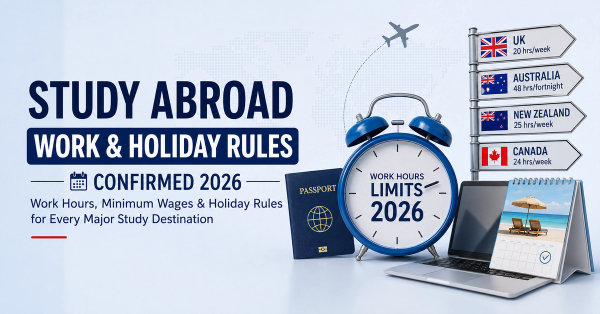
| 🇦🇺 Australia | AUD 20–50K/yr | 48 hrs/fortnight ✔ | 485 Visa: 2–4 yrs ✔ | Clear — 189/190 ✔ | Yes ✔ | Level 3 ⬆ Risk |
| 🇨🇦 Canada | CAD 15–40K/yr | 20 hrs/week | PGWP: up to 3 yrs ✔ | Express Entry ✔ | Yes ✔ | Grad Exempt — New ✔ |
| 🇬🇧 UK | £18–35K/yr | 20 hrs/week | Grad Route: 2–3 yrs | Possible — slow ⚠ | Yes ✔ | Dependants restricted ⚠ |
| 🇺🇸 USA | USD 25–55K/yr | On-campus only ⚠ | OPT: 12–36 months | None — H-1B lottery ✗ | Yes ✔ | Political uncertainty ⚠ |
| 🇯🇵 Japan | JPY 535K–1.5M/yr | 28 hrs/week | Designated activities ⚠ | Limited — growing ⚠ | Mostly Japanese ⚠ | More English options ✔ |
| 🇩🇪 Germany | €0 + €150–350 fee | 20 hrs/week | 18-month job-seeker ✔ | 21 months work → PR | German req. most UG ⚠ | More English Master's ✔ |
| 🇳🇿 New Zealand | NZD 22–35K/yr | 20 hrs/week | Post-Study: 1–3 yrs | Possible — slower ⚠ | Yes ✔ | Stable |
Top Scholarships for Nepali Students in 2026
| Country | Scholarship Name | What It Covers | Level |
|---|---|---|---|
| 🇦🇺 Australia | Australia Awards Scholarship | Full tuition + living stipend + airfare | Master's / PhD |
| 🇦🇺 Australia | Destination Australia | Tuition + living support (regional study) | All levels |
| 🇨🇦 Canada | Vanier Graduate Scholarship | CAD 50,000 per year | PhD (STEM focus) |
| 🇬🇧 UK | Chevening Scholarship | Full tuition + living allowance + airfare | Master's only |
| 🇺🇸 USA | Fulbright FFSP Nepal | Full tuition + stipend + airfare | Master's (~4 seats/yr) |
| 🇯🇵 Japan | MEXT Government Scholarship | Full funding — multiple streams | All levels |
| 🇩🇪 Germany | DAAD Scholarship | Monthly stipend + health insurance | Master's / PhD |
| 🇳🇿 New Zealand | Manaaki NZ Scholarship | Full tuition + stipend + travel | Master's / PhD |
Match Your Goals to the Right Destination
→ Canada (Express Entry + 3-yr PGWP). Skilled graduates can obtain PR in as little as 6–12 months after graduation. Alternatively, → Regional Australia adds an extra year of post-study work rights plus bonus PR migration points.
→ USA for world-ranked STEM, medicine, and research institutions. → UK for Oxford, Cambridge, Imperial, and the LSE — especially in a fast 1-year master's format.
→ Germany is the clear winner — €0 tuition at public universities. → Japan is second — especially with the MEXT scholarship.
→ Australia is the clear leader — 48 hours per fortnight during semester, unlimited during breaks. At AUD 24.95/hr minimum wage, a working student can earn AUD 1,000–1,400/month during term.
→ Canada is the strongest single choice for 2026 — no cap, 14-day PhD processing, PGWP, and Express Entry PR. → UK is ideal for a fast 1-year master's from a prestigious institution.
→ Australia and → Canada remain the two strongest options for family-accompanied study. Canada's PhD fast-track includes family members in the same processing window.
→ Germany or → Japan may be more accessible — particularly if you're willing to study in that country's language. Ask Admizz Education about pre-sessional English pathway programs.
→ New Zealand consistently has the most accessible process for Nepali students. → Japan and → Germany also have relatively clear processes.
FAQ: Best Country for Nepali Students 2026
So — Which Country Should You Actually Choose?
The honest answer is that it depends — but not arbitrarily. There is a right answer for your specific profile, and it is usually far clearer than it feels when you are staring at a list of seven countries.
If you want the widest combination of benefits — degree quality, work rights, community support, and a clear PR pathway — Australia is still the overall winner in 2026. Assessment Level 3 has made the process more demanding, but not impossible, for well-prepared applicants. Meanwhile, if you are pursuing a graduate degree and care most about the route to permanent residency, Canada in 2026 is arguably more attractive than it has been in years — especially at master's and PhD level. And if your primary constraint is cost, Germany offers something no other country does: a world-class degree at essentially zero tuition.
What is clearer than ever in 2026 is that rushed, poorly prepared applications are failing — while thorough, well-documented ones are succeeding across every destination on this list. Every step of the process rewards preparation and penalises shortcuts. Whichever destination you are considering, the time to start is now.
Talk to Counselor Today