
Your complete FAQ on applications, visas, costs & life after graduation
Thinking about studying in the UK? From choosing the right programme to understanding visa rules and working rights, the process can feel overwhelming. At Admizz Education, we've put together this comprehensive FAQ guide — packed with everything international students need to know before, during, and after their UK studies.
When should I start my UK university application?
Start as early as possible. Most postgraduate courses begin in September or October, with application deadlines in June or July — but intake windows can open as early as March. High-demand fields like health sciences and business fill up fast, so applying the moment the window opens is strongly recommended.
What documents are required for a UK university application?
While it varies by programme, most applications require a personal statement or statement of purpose, a resume/CV, a copy of your passport, proof of financial support, official transcripts, and proof of English language proficiency.
What is a CAS and why do I need it?
CAS stands for Confirmation of Acceptance for Studies — a unique reference number issued by your university once you accept an unconditional offer. You must have a CAS before you can apply for your UK Student visa. Without it, your application cannot proceed.
Which UK student visa do I need?
If you are 16 or older pursuing higher education, you need a Student visa. If you are between 4–17 years old attending an independent (private) school, apply for a Child Student visa instead.
When can I apply for my UK Student visa?
If applying from outside the UK, you can apply up to six months before your course begins. If applying from inside the UK, you can apply up to three months before your start date.
What is a UK Credibility Interview?
Before issuing your CAS, some universities may require a credibility interview to verify that your intent to study in the UK is genuine, assess your spoken English, and confirm you understand the details of your chosen course. Preparation is key — know your course content, career goals, and why you chose that university.
Will I get a physical visa card (BRP)?
No. As of late 2025, the UK fully phased out physical Biometric Residence Permits (BRPs) and paper vignettes. Your visa status is now entirely digital (an eVisa). You prove your right to study and work via a UKVI digital account.
Admizz tip: Set up your UKVI digital account well before your departure date. Access issues can delay your ability to prove your immigration status to landlords and employers in the UK.
How much money do I need to show for my visa application?
You must prove "financial capacity" — enough to cover travel, your first year's tuition, and living expenses. As of 2026, the monthly living expense requirement is:
London
£1,529
per month, up to 9 months
Outside London
£1,171
per month, up to 9 months
⚠️ Crucial rule: These funds must sit in your bank account for a minimum of 28 consecutive days, and your bank statement must be dated within 31 days of your visa application.
How much does it generally cost to study in the UK?
Total annual costs (tuition + living expenses) typically range from £35,000 to £62,000. For undergraduate courses alone, international tuition usually ranges between £11,400 and £38,000 per year.
How many hours can I work while studying?
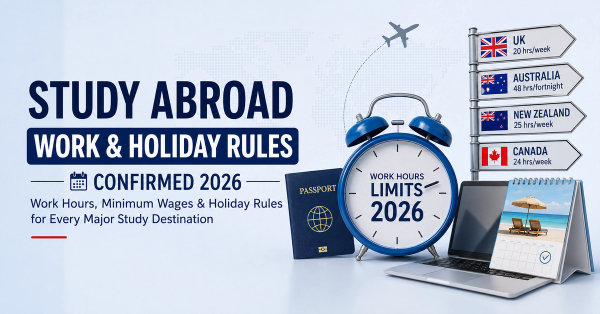
Students at degree level or above can work up to 20 hours per week during term time. Those studying below degree level are limited to 10 hours per week. During vacation periods, full-time work is permitted. Note: postgraduate students writing dissertations over summer are typically still considered to be in term time.
Are there restrictions on the type of work I can do?
Yes. Student visa holders are strictly prohibited from certain work types:
Permitted types of work include:
Can I stay in the UK after graduating?
Yes — through the Graduate Route visa. Currently it allows graduates to stay for 2 years (3 years for PhD graduates) if applying before 31 December 2026. From 1 January 2027, this is scheduled to reduce to 18 months for most graduates. The Graduate Route offers more flexibility than a Student visa, including permission for self-employment and permanent roles.
Time-sensitive: If you are planning to study in the UK, applying before the end of 2026 gives you access to the current 2-year Graduate Route. This is a significant advantage worth factoring into your timeline.
How do I prove my English proficiency?
For visa purposes, the most common method is a government-approved Secure English Language Test (SELT) — such as specific tests offered by IELTS or Pearson. Your university will also assess your English skills as part of the admissions process.
Can I bring my family with me to the UK?
Depending on your course level and type, you may be able to bring dependents — a spouse, civil/unmarried partner, or children under 18. You will need to provide proof of relationship (e.g. a marriage or birth certificate) and demonstrate you have the additional financial capacity to support them throughout your stay.
Ready to begin your UK journey?
Let Admizz Education guide you every step of the way
Talk to an Admizz advisor →Talk to Counselor Today