Something Changes for Every F-1 Student on September 15
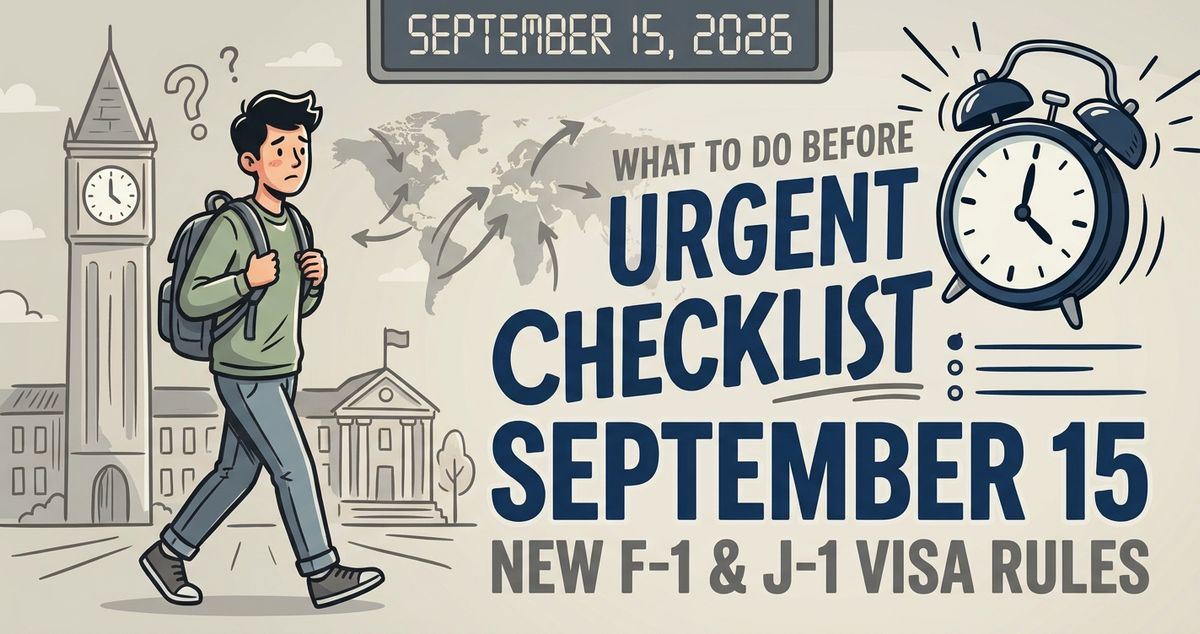
US universities across the country are urgently contacting their international students with the same message: understand what is changing on September 15, 2026 — and act before it arrives. On that date, the most significant change to US student immigration in decades goes live. The system that has governed how long international students can stay in the United States — Duration of Status — is being replaced with a fixed time limit, printed directly on your I-94 arrival record.
This is not a minor administrative update. It changes how long you can legally remain in the US, what happens if you travel internationally and return after September 15, and what you must do if your studies take longer than your permitted period. Every current and prospective F-1 and J-1 student needs to understand this before the deadline arrives.
What Exactly Changes on September 15
Until September 14, 2026, your F-1 visa stamp allows you to enter the United States and your I-94 record shows "D/S" — Duration of Status. This meant you could stay for the full length of your programme plus any authorised practical training, with no fixed end date. Your university's Designated School Official (DSO) had the authority to extend your stay if you needed more time.
From September 15, 2026, that changes entirely. Here is what the new system looks like:
| Factor | Before September 15 | From September 15 |
|---|---|---|
| I-94 entry record | Shows "D/S" — no end date | Shows a fixed calendar end date |
| Maximum stay | Full programme length + OPT | Up to 4 years (most students) |
| Language students | D/S for programme duration | Maximum 24 months |
| Extension authority | Your university DSO | USCIS only — full application required |
| Changing programmes | Permitted with DSO approval | Restricted — undergraduate first year; graduate students cannot change |
| Grace period after study | 60 days | 30 days |
| Second degree at same level | Permitted | Extension not granted |
The Travel Warning — Read This Before You Book Any Flights
This is the most urgent practical issue for students currently in the US. If you leave the United States and re-enter after September 15, 2026, you will receive a new I-94 under the new rules — with a fixed end date. Even if you entered the US before September 15 with a D/S stamp, returning after the deadline means your re-entry is processed under the new system.
Universities are specifically warning students who plan to travel internationally around the September to December period to understand this before they go. A student who flies home for a family occasion in October and returns in November will re-enter under the new fixed-date system — even if they have been on D/S status for years.
Who Is Most at Risk From This Change
- PhD and doctoral students: The average PhD in the United States takes 5–8 years. The 4-year maximum means virtually every international doctoral student will need to file a USCIS extension — an application that involves fees, documentation, and no guarantee of approval. This is the group facing the greatest disruption from the September 15 change.
- Students on language or foundation programmes: The new 24-month maximum for English-language students is significantly shorter than the time many students spend completing intensive English before progressing to a degree. Language students need to plan their transition carefully and urgently.
- Students nearing the end of their 4-year period: If your cumulative F-1 time in the US is approaching four years — including any previous study periods — your I-94 end date under the new system may arrive sooner than you expect. Check your history carefully.
- Students planning to travel internationally this autumn: As above — any student leaving and re-entering the US after September 15 will be processed under the new rules, regardless of their previous D/S status. This is not a theoretical concern — it is happening immediately.
- Students planning to change their programme or transfer university: Graduate students cannot change programmes at any point under the new rules. Undergraduate students cannot change in their first year. If you were planning a transfer or programme change, speak to your DSO before September 15.
What to Do Right Now — Before September 15
- Check your I-94 record at i94.cbp.dhs.gov Log in and confirm whether your current I-94 shows D/S or a fixed date. This tells you exactly where you stand before the September 15 change. If it shows D/S and you are planning to remain in the US, your existing stay is not immediately affected — but any re-entry after September 15 will be.
- Contact your university's international student office this week Do not wait. Book an appointment with your DSO specifically to discuss how September 15 affects your programme, your expected graduation timeline, and any travel plans you have this year. Universities are advising students proactively — take advantage of that support.
- Do not book international flights for after September 15 without advice first Before purchasing any travel that takes you out of the US after September 15 and brings you back, confirm with your DSO how re-entry under the new rules will affect your specific I-94 end date and your remaining authorised period.
- If your programme takes more than 4 years — plan your extension now If you are in a programme that cannot realistically be completed within four years — particularly doctoral, research, or combined degree programmes — begin gathering the documentation needed for a USCIS extension application. Extensions are not guaranteed and processing takes time. Starting early is essential.
- If you are considering a programme change or transfer — decide before September 15 Once the new rules are in effect, graduate students cannot change programmes and undergraduates cannot change in their first year. If you have been considering a transfer or programme change, September 15 is a hard deadline for that flexibility.
What the UK, Australia and New Zealand Still Offer — Without a Fixed Deadline
The September 15 change has prompted many students weighing their options to look again at alternative destinations — where post-study flexibility, clear extension pathways, and genuine student support remain intact. Here is a quick honest comparison for students making that decision now:
Frequently Asked Questions
Talk to Counselor Today