What Is the Fulbright Foreign Student Program?
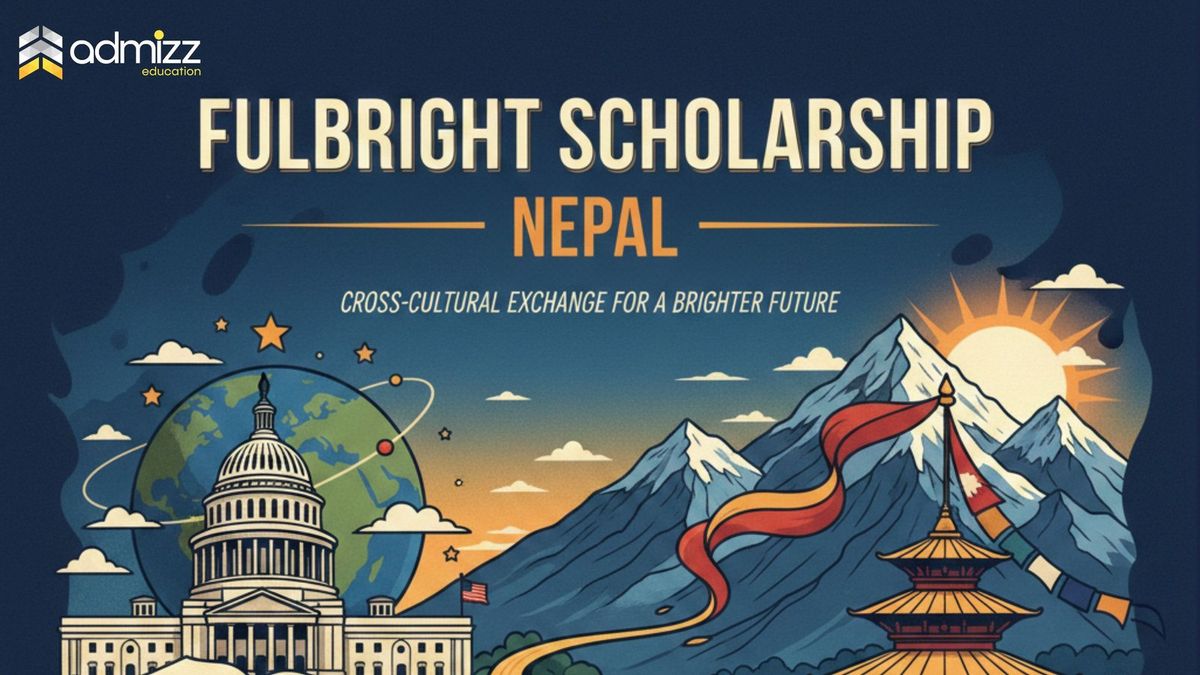
The Fulbright Foreign Student Program (FFSP) is the United States government's flagship international educational and cultural exchange initiative, administered globally by the Institute of International Education (IIE) and in Nepal by the U.S. Educational Foundation in Nepal (USEF-Nepal) — also known as the Fulbright Commission.
For Nepali students, the FFSP funds a fully-paid Master's degree at selected US universities. The program is designed to promote mutual understanding between Nepal and the US through the exchange of knowledge and professional talent. Since its inception, the global Fulbright Program has supported approximately 370,000 participants across more than 160 countries.
Selected participants for the 2027-28 cycle will begin their studies in Fall 2027. Candidates in STEM fields and Business Management are especially encouraged to apply.
Grant Benefits & What It Covers
The Fulbright FFSP is a comprehensive, fully-funded scholarship. Grantees pay nothing out of pocket — the program is designed so scholars can focus entirely on their academic and professional goals without financial worry.
Eligibility Requirements
To be considered for the Fulbright FFSP from Nepal, applicants must meet all of the following criteria as of the application deadline:
Who Is NOT Eligible?
The following categories of applicants are automatically disqualified from the Fulbright FFSP from Nepal:
- Individuals currently living, studying, or working outside Nepal at the time of application
- Those who have resided in the United States for six months or more during the five years preceding the application deadline
- Individuals who already hold a US degree (preference given to applicants without prior US or foreign study experience)
- Students with a 3-year bachelor's who have completed only the first year of a 2-year Master's programme
- Master's students who have cleared all exams but have not yet fulfilled other university-mandated degree requirements
- Students holding two or more 2-year/3-year bachelor's degrees but no Master's degree
- Applicants seeking a degree in Medicine or Nursing
- USEF-Nepal employees, local US Mission Nepal (Department of State) staff, and their spouses and dependent children — during employment and for one year after termination
Required Documents Checklist
All applications are submitted online via the IIE portal — no hard copies are accepted. Prepare the following documents before you begin your application:
| Application Section | Document Required |
|---|---|
| CV / Résumé | Maximum 2 pages, following the USEF-Nepal CV format |
| Academic Materials | Attested copies of all diplomas/certificates and mark sheets/transcripts from SLC to most recent degree — arranged in reverse chronological order. Unattested materials will not be accepted. |
| Study Plan Essays | Study/Research Objective (max 2 pages / 1,500 words) and Personal Statement (max 2 pages / 1,500 words). A Writing Sample is often required for Humanities and Social Sciences. |
| Identity Document | Scanned copy of Nepali Citizenship Certificate, National ID, or Passport |
| Recommendations | 3 letters of recommendation (professional and academic referees). Recommenders must submit directly online through the application system before the deadline. |
| Test Scores | TOEFL/IELTS and GRE score reports — not mandatory at application stage. Prior valid scores may be submitted if available. |
| Work Sample (if applicable) | Often required for study in the Arts, Communication, or Journalism fields |
Step-by-Step Application Process
The complete Fulbright application process is online through the IIE portal. Here is the full journey from start to grant notification:
Visit the USEF-Nepal website (usefnepal.org) and access the official IIE application portal. Sign up and start a new application for the 2027-28 FFSP cycle. No hard copies are accepted at any stage.
Collect attested photocopies of all diplomas, certificates, and transcripts from SLC to your most recent degree, arranged in reverse chronological order. Drop originals at USEF-Nepal for attestation if needed (10 AM–4 PM).
Clearly articulate your academic and career goals: what you aim to study, why you need a US Master's degree specifically, and what outcomes you intend to achieve. Maximum 2 pages or 1,500 words.
Share your story — your strengths, key experiences, any challenges or inconsistencies in your academic or professional history, and how they have shaped your goals. Maximum 2 pages or 1,500 words.
Choose 3 recommenders (professional and academic) who know you well and can speak to your abilities. Your professional recommender must specifically verify your position, years of employment, and relevance to your proposed field. They submit online directly.
List at least 4 US institutions where you would like to study, aligned with your academic and professional goals. Research each university's programme carefully before listing them.
Fill in all sections of the IIE portal, review carefully for accuracy, acknowledge the plagiarism agreement, and submit before 11:59 pm NPT, April 30, 2026. Late or incomplete applications are not accepted.
Shortlisted candidates are notified and called for panel interviews in June 2026. Interviews evaluate your academic background, English communication skills, professional experience, and plans for contributing to Nepal after returning.
Selected candidates take GRE and/or TOEFL tests in July–September 2026. These are offered free of charge by the Fulbright Commission. Prior valid test scores may be accepted.
Final nominees are forwarded to IIE in Washington for university placement. Subject to budget, approximately 4 candidates from Nepal are selected. Successful grantees commence their programmes in Fall 2027.
Official Application Timeline (2026–27 Cycle)
The official 2027-28 Fulbright FFSP timeline from USEF-Nepal is as follows:
Key Elements of a Successful Application
The Fulbright Committee in Nepal selects only around 4 candidates per year — competition is intense. Based on official USEF-Nepal guidance and alumni insights, here is what separates winning applications:
Thoroughly review the application instructions. Double-check that all required documents are uploaded correctly, and answer every question with accuracy and completeness.
Clearly articulate what you aim to study, your academic and career goals, and why a US Master's is specifically needed to achieve them. Vague or generic statements fail.
Your Personal Statement should share your strengths, key experiences, and any inconsistencies in your academic/professional history — and how these shaped your goals.
Fulbright values scholars who will return and contribute to Nepal. Describe concrete post-degree plans — a specific role, sector, or initiative you plan to pursue in Nepal.
Select referees who know you well and can provide unique, well-rounded insights. Brief them on what to emphasise. In US culture, the content of a recommendation matters more than the referee's title.
List all postsecondary institutions in reverse chronological order. Include all academic, professional, and personal awards and honours received.
Research programmes that align with your academic and professional goals and list at least four institutions. Specific, well-researched choices signal seriousness and fit.
Be aware that individual universities may have AI usage guidelines. Carefully read and agree to the Fulbright plagiarism policy. Plagiarism results in immediate disqualification.
Frequently Asked Questions
When does the Fulbright FFSP application open and close for Nepal?+
Do I need GRE or TOEFL scores to apply?+
How much work experience do I need to apply from Nepal?+
Can I apply if I am currently living, studying, or working outside Nepal?+
Can I apply if I already hold a Master's degree?+
Which documents need to be attested and how?+
Can I convert my GPA to percentage or vice versa?+
Which fields of study can I pursue under the Fulbright FFSP?+
What is the J-1 two-year home residency requirement?+
Can I re-apply if I was rejected in a previous year?+
Contact & Official Resources
For the most accurate and up-to-date information, always refer directly to USEF-Nepal (the official Fulbright Commission in Nepal). Be cautious of unofficial sources.
Mon–Fri, 10 AM – 4 PM
Talk to Counselor Today